Just for kicks, I've been thinking the past few days about what I thought have been some of the biggest news stories of 2007. Here is a list that I thought of - by no means in order of importance or chronology. Just some headline grabbers:
1. The Surge/Petreas Report/Iraq
Although this has fallen from the headlines of late, I think this was probably the biggest story of the year to me. The President's decision to increase troop levels in order to provide stability to generate a political settlement; the unquestioned success of the military in acheving that increased stability/decreased violence; Gen. Petraus and Ambassador Crocker testifying solely to the security side of the equasion; and finally, the Bush Administration, politicians, and the mainstream media completely ignoring the fact that, again, our military's steller success is being squandered by politicians who are unable to find settlement.
2. The '08 Presidential Nomination Campaigns
It's been a fun race with a surprising number of contenders for the nomination in both party's keeping the race wide open.
3. Iran
Both the increasing leverage and threat Iran poses as a legitimate regional hedgmon, and the intelligence community's surprising uprising against the Bush Administrations drum-beat to war on a third front.
4. Upheaval in Pakistan/Bhutto Assination
Pakisatan was already devolving, led by a military dictator ditinguishable from Sadaam Hussein only in degrees. The assination of Bhutto was tragic to a new middle class seeking legitimate democracy. The Bush Administration once again demonstrates its utter incompetence and lack of wisdom by un-hedged support of an anti-democratic dictator.
5. Resurgance of the Taliban in Afghanistan
Fueled by drug profits that the Bush Administration (in an all too familiar refrain) does not have the competence or intelligence to curtail, the Taliban and Al Queada is finding renewed strength in Afghanistan, where the US troops are stretched thin by the Surge in Iraq.
6. Mortgage madness/Sub-prime lending mess
I'm not convinced this will end up being as bad for the average American as the "If it Bleeds it Leads" media's bold-typed headlines would indicate, but there is no question that financial mismanagement and over-reaching has taken its toll on some of Wall Streets biggest firms.
7. The VT Shootings
Just a tragedy that defies explanation.
8. Oil Prices
With all the volitility in the world, this should not come as a surpise, but it flat out does come with upside. The higher oil prices reach, the more cost-efficient research into alternative fuels and alternative transportation becomes.
9. The Final Chapter of Harry Potter
It was somewhat sad, to me, to read the conclusion of this wonderful series. I've enjoyed every moment of it, and will probably continue to do so long into the future through re-readings.
10. Baseball's Steroid Scandal/Bonds' homerun record
Just ugly. The Mitchell report was damning, but it feels more like the closing chapter on a nasty era than the beginning of anything. And Bonds got his HR record, but received as little media attention (for the record) as could possibly be imagined.
11. AG/AG - The Improbable rise, and Cataclysmic Fall of Alberto Gonzalez
Just a mess of an Attorney General, Bush's fiercest Yes-Man could not withstand the cascading pressure of scandal after scandal after scandal after scandal.
12. Houston Dynamo Repeat as MLS Champions
Okay, this is much more local, and just a personal favorite, but to me, the improbale journey of this team from mediocre, at best, to repeast MLS Champs was really amazing. I've never supported a champion in any sport - and now I get two back-to-back. It's great, and it's all the better to support an organization that builds its team as a team, and players who really do define hard-working, team-first attitude. Good on you Dynamo - let's get another next year!
Showing posts with label Miscellaneous. Show all posts
Showing posts with label Miscellaneous. Show all posts
Monday, December 31, 2007


Tuesday, August 14, 2007
New Format...
I have "upgraded" the blog to a slightly different layout. I don't know if it is really an update or not, but I think there are some nice new features. If you have any opinion, criticism, or suggestion for the blog format, please comment and let me know.
Positives: This new layout allows for a whole LOT more links - and much easier managment of links. In addition, I really like the new feature where you can search the blog by topic Label (on the right under the links). I think that will be really useful. (Just FYI - I have gone back and added labels to a majority of my old posts, but there are still a few more to go.) Finally, I think this format provides a more useful Archive feature.
Negatives: There are a lot more links - maybe it's too many? Too bulky over on the right side of the blog? Also, I don't like the picture I have up at the top currently, and the way it does not stretch the entire width of the page. I'll have to work on that.
Anyway, I think overall, this new layout will be efficient and helpful. It's just hard getting used to new stuff - once you are so comfortable with the old. Anyway, comments about the format/layout of the blog are appreciated.
Positives: This new layout allows for a whole LOT more links - and much easier managment of links. In addition, I really like the new feature where you can search the blog by topic Label (on the right under the links). I think that will be really useful. (Just FYI - I have gone back and added labels to a majority of my old posts, but there are still a few more to go.) Finally, I think this format provides a more useful Archive feature.
Negatives: There are a lot more links - maybe it's too many? Too bulky over on the right side of the blog? Also, I don't like the picture I have up at the top currently, and the way it does not stretch the entire width of the page. I'll have to work on that.
Anyway, I think overall, this new layout will be efficient and helpful. It's just hard getting used to new stuff - once you are so comfortable with the old. Anyway, comments about the format/layout of the blog are appreciated.
Thursday, July 12, 2007
I'm confused. I thought right-wingers were FOR prayer...
Talk about an ironic man-bites-dog story:
Hindu prayer in Senate disrupted
I am a Christian who believes in the clear separation of church and state. One of the reasons is this right here. If I would choose not to have my child exposed to Hindu, Muslim, Jewish, or any other sorts of prayers in public school, or public events; why would I be so arrogant as to exect Hindus, Muslims, Jews, or anyone else to accept forced exposure to the prayers of my religion? The arrogance and hypocracy of screaming for public prayer, then screaming when it's not your prayer being offered.
A little more relationship with God, and a little less of using 'god' as an election tactic would serve right-wingers well.
Hindu prayer in Senate disrupted
A Hindu clergyman made history Thursday by offering the Senate's morning prayer, but only after police officers removed three shouting protesters from the visitors' gallery.
Rajan Zed, director of interfaith relations at a Hindu temple in Reno, Nev., gave the brief prayer that opens each day's Senate session. As he stood at the chamber's podium in a bright orange and burgundy robe, two women and a man began shouting "this is an abomination" and other complaints from the gallery.
Police officers quickly arrested them and charged them disrupting Congress, a misdemeanor. The male protester told an AP reporter, "we are Christians and patriots" before police handcuffed them and led them away.
For several days, the Mississippi-based American Family Association has urged its members to object to the prayer because Zed would be "seeking the invocation of a non-monotheistic god."
...
Barry W. Lynn, executive director of Americans United for Separation of Church and State, said the protest "shows the intolerance of many religious right activists. They say they want more religion in the public square, but it's clear they mean only their religion."
I am a Christian who believes in the clear separation of church and state. One of the reasons is this right here. If I would choose not to have my child exposed to Hindu, Muslim, Jewish, or any other sorts of prayers in public school, or public events; why would I be so arrogant as to exect Hindus, Muslims, Jews, or anyone else to accept forced exposure to the prayers of my religion? The arrogance and hypocracy of screaming for public prayer, then screaming when it's not your prayer being offered.
A little more relationship with God, and a little less of using 'god' as an election tactic would serve right-wingers well.
Thursday, April 26, 2007
Best Show on TV...
The Philadelphia Inquirer carried a good feature on John Stewart and the Daily Show today - What's a funnyman to say of grim news?
The Daily Show and The Colbert Report are both programmed on our DVR machine at home. I think that these are two of the best shows currently on TV because they are both somehow able to simultaneously be irreverent & hysterically funny and also thought provoking & provide actual information.
The Inquirer piece notes how Stewart and the show had to deal with the horrible events at Virginia Tech last week:
I'm anticipating that the Daily Show coverage of the 2008 Election will be appropriately over-the-top given the over-the-top personalities involved in the election...but, that will also mean that Stewart's regular spot-light upon the incompetence of the Bush administration will be coming to an end.
Well, I guess I won't have to miss it after all...
The Daily Show and The Colbert Report are both programmed on our DVR machine at home. I think that these are two of the best shows currently on TV because they are both somehow able to simultaneously be irreverent & hysterically funny and also thought provoking & provide actual information.
The Inquirer piece notes how Stewart and the show had to deal with the horrible events at Virginia Tech last week:
So what's a fake anchorman to do? Find something else to be funny about.
"I will do what I always do when faced with something that is that powerfully damaging to the emotional core," Stewart said at the top of Monday's show. "I will begin to repress it, and swallow it . . . so let's move on, as if the world was OK."
"The main thing is to overcome your own sense of gloom," Stewart said the next day from his Manhattan office. The New Jersey native brings his stand-up comedy act to the Tower Theater in Upper Darby for two shows Friday.
"Our saving grace is that we're not the news, so we have no obligation to be the news. Our job is comedy, though the foundation of a lot of what we do is not particularly lighthearted. And it's not that horrible situations cannot make for something satirical or absurd. It's just that in the middle of the immediacy of something like this, you're fighting your own nausea."
I'm anticipating that the Daily Show coverage of the 2008 Election will be appropriately over-the-top given the over-the-top personalities involved in the election...but, that will also mean that Stewart's regular spot-light upon the incompetence of the Bush administration will be coming to an end.
Though the sitting president is Stewart's most frequent comic target, the satirist says he won't miss Bush when he leaves office. "People used to say, 'When Clinton goes, what are you going to do without him?' I have complete faith in the continued absurdity of whatever's going on.
"And besides that, I look forward to deconstructing someone else's game. At a certain point there's no more surprises. You know [the Bush administration is] going to come out and say the opposite of what most people believe reality to be as adamantly as they possibly can. . . . And I'm pretty much done with that. I'm ready to move on to another form of deception."
Well, I guess I won't have to miss it after all...
Thursday, April 19, 2007

Wednesday, April 11, 2007
Don't Underrate Houston...
MSNBC.com has an interesting article up about the most underrated cities in America - Top 10 underrated U.S. cities; Sure, N.Y., Chicago, S.F. are nice, but don't forget these overlooked locales
The list includes a few that I would have expected (Pittsburgh, Portland) - and also includes my hometown. Here is the write up for #3 must underrated city - Houston, Texas:
Very nice.
And I'd just like to add that Dallas didn't make the list...
The list includes a few that I would have expected (Pittsburgh, Portland) - and also includes my hometown. Here is the write up for #3 must underrated city - Houston, Texas:
Houston is proof that everything is indeed bigger in Texas. While better known for its big business and energy interests, this sprawling city also hosts top-notch orchestra, opera, and ballet companies, a dynamic theater scene, great museums, and the world-renowned NASA Space Center. Shopping reigns supreme here — you'll find a huge concentration of shops and above-par outlet malls — and its cosmopolitan restaurant scene expands upon the state's traditional Tex-Mex offerings. Bold and impressive architecture helps define the cityscape, too — including the mammoth Astrodome — making this fourth-largest U.S. city a true star in the Lone Star State.
Very nice.
And I'd just like to add that Dallas didn't make the list...
Wednesday, March 07, 2007
Heavy lifting...
Lately, I have been thinking a lot about the fact that there are times when America doesn't seem willing to do the heavy lifting when it comes to national security concerns. Specifically, last night I was thinking about the fact that we seem unable to accept what may end up being either higher prices, or higher taxes, in order to support certain industries (example: steel) in order to secure our defense and security.
What do I mean? While I'm a true believer in a market-based economy, I think that in order to secure a common defense, we need to have a strong steel industry in America. What happens if the entire US steel industry closes shop because steel is able to be acquired in a more efficient and less costly manner overseas? But then what happens when we're at war and need to build aircraft carriers, tanks, and armored jeeps? Or bring it closer to home - our troops have suffered in Iraq due to lack of body armor and lack of armor on troop carrier and humvee-type vehicles. One of the justifications for these failures is the lack of supply. So, why haven't we REQUIRED it? Why hasn't this government been willing to force our industry to make sacrifices in order to provide such equipment to our troops? Or us, as citizens, why didn't they ask us to pay $5 or $10 each to be used to support some company to get this equipment to our troops?
Well, with that on my mind, I read Thomas L. Friedman's column today (I read it in the print edition of the Houston Chronicle, but it is published originally in the New York Times - paid subscription required to read online). His column reflects much of my recent thinking - although in a bit of a different perspective. The title of the piece is "Who's supporting the out of sight, out of mind troops?"
Something that is not said directly in that column, but lurks in the background, is that leadership often means calling for people to work collectively toward solving problems - not merely championing individual success. Roosevelt never minced words with the American people. He never told us that we could contribute to the war effort by going shopping, or on vacation. He told us it would be expensive, hard, long - and that we were all responsible for working together to make is successful. That would seem natural at a time of war, but all you have to do is look at the current Presidential Administration to realize that it is not.
It takes leadership to call for collective action - and call for the heavy lifting to be done by all of us. But can't we do that? I think that American's are more than willing to do it. I think that if we were asked to, we would be willing to pay more for products that use US steel. I think that, as Friedman suggests, if we were asked, we'd be willing to pay a "Patriot Tax" of 50 cents and invest the money to diminish our dependence on oil. I think that - if we'd only been asked - we would have done whatever it took to get our soldiers body and vehicle armor.
I believe America is ready and willing to do the heavy lifting - if only we had leaders that would ask.
What do I mean? While I'm a true believer in a market-based economy, I think that in order to secure a common defense, we need to have a strong steel industry in America. What happens if the entire US steel industry closes shop because steel is able to be acquired in a more efficient and less costly manner overseas? But then what happens when we're at war and need to build aircraft carriers, tanks, and armored jeeps? Or bring it closer to home - our troops have suffered in Iraq due to lack of body armor and lack of armor on troop carrier and humvee-type vehicles. One of the justifications for these failures is the lack of supply. So, why haven't we REQUIRED it? Why hasn't this government been willing to force our industry to make sacrifices in order to provide such equipment to our troops? Or us, as citizens, why didn't they ask us to pay $5 or $10 each to be used to support some company to get this equipment to our troops?
Well, with that on my mind, I read Thomas L. Friedman's column today (I read it in the print edition of the Houston Chronicle, but it is published originally in the New York Times - paid subscription required to read online). His column reflects much of my recent thinking - although in a bit of a different perspective. The title of the piece is "Who's supporting the out of sight, out of mind troops?"
Leadership is about enabling and inspiring people to contribute in time of war so the enemy has to fight all of us -- not insulating the public so the enemy has to fight only a few of us.
If you want to compare President Bush in this regard with Presidents Roosevelt or Wilson, pick up a copy of Robert Hormats's soon-to-be-published book: ''The Price of Liberty: Paying for America's Wars.''
''In every major war that we have fought, with the exception of Vietnam, there was an effort prior to the war or just after the inception to re-evaluate tax and spending policies and to shift resources from less vital national pursuits to the strategic objective of fighting and winning the war,'' said Mr. Hormats, a vice chairman of Goldman Sachs (International).
He quotes Roosevelt's 1942 State of the Union address, when F.D.R. looked Americans in the eye and said: ''War costs money. That means taxes and bonds and bonds and taxes. It means cutting luxuries and other nonessentials. In a word, it means an 'all-out' war by individual effort and family effort in a united country.''
Ever heard Mr. Bush talk that way?
Something that is not said directly in that column, but lurks in the background, is that leadership often means calling for people to work collectively toward solving problems - not merely championing individual success. Roosevelt never minced words with the American people. He never told us that we could contribute to the war effort by going shopping, or on vacation. He told us it would be expensive, hard, long - and that we were all responsible for working together to make is successful. That would seem natural at a time of war, but all you have to do is look at the current Presidential Administration to realize that it is not.
It takes leadership to call for collective action - and call for the heavy lifting to be done by all of us. But can't we do that? I think that American's are more than willing to do it. I think that if we were asked to, we would be willing to pay more for products that use US steel. I think that, as Friedman suggests, if we were asked, we'd be willing to pay a "Patriot Tax" of 50 cents and invest the money to diminish our dependence on oil. I think that - if we'd only been asked - we would have done whatever it took to get our soldiers body and vehicle armor.
I believe America is ready and willing to do the heavy lifting - if only we had leaders that would ask.
Friday, December 01, 2006
World Aids Day...
Don't forget...
************************************************************************

Today is World Aids Day. The idea of the world-wide day of awareness is to encourage the international community to step up to the plate and fight the disease.
The theme of this World Aids Day is accountability. There will be international observances calling for nations of the world, and international organizations to keep their committmens in fighting AIDS.
Clearly, the AIDS pandemic is at its devastating worst in the poorest areas of the world. The expense of getting AIDS treatment drugs, combined with lack of proper medical facilities, labratory testing facilities, and proper basics such as nourishment and hygiene make fighting AIDS in developing portions of the world extremely difficult. But it is clearly not a lost cause.
A study to be published in the New England Journal of Medicine today reveals that a holistic approach - even in the poorest areas - can be successful. The study shows that low-cost treatment programs can dramatically increase survival rates in poor countries.
That is a rather staggering improvement - especially for the children. And - it's economically efficient:
If you are able to spend a paltry $1,600 and re-gain a functioning memeber of the community, who is able to go back to work...or if a child, is able to grow up and contribute to the community - that is a bargain.
But of course, the poorest regions of Africa, central America, and Asia are not the only places where there is suffering from this disease. Even here, in one of the wealthiest nations of the world, people struggle with AIDS - and at all levels, the poor, middle class, and even the wealthy. AIDS is no respecter of income. And even though many here in America are able to take advantage of drugs and treatment which enables them to live strong, vibrant lives - there still is no cure...which I was reminded of all to closely this year. Much has been done, but there is so much left to do.
A few more links:
UNAIDS
US Dept. of State
Kaiser Family Foundation
Stop AIDS. Keep the promise.
************************************************************************
From December 1, 2005.
************************************************************************

Today is World Aids Day. The idea of the world-wide day of awareness is to encourage the international community to step up to the plate and fight the disease.
The theme of this World Aids Day is accountability. There will be international observances calling for nations of the world, and international organizations to keep their committmens in fighting AIDS.
Clearly, the AIDS pandemic is at its devastating worst in the poorest areas of the world. The expense of getting AIDS treatment drugs, combined with lack of proper medical facilities, labratory testing facilities, and proper basics such as nourishment and hygiene make fighting AIDS in developing portions of the world extremely difficult. But it is clearly not a lost cause.
A study to be published in the New England Journal of Medicine today reveals that a holistic approach - even in the poorest areas - can be successful. The study shows that low-cost treatment programs can dramatically increase survival rates in poor countries.
Typically only 30 percent of AIDS patients survive for one year in Haiti, the poorest country in the Western Hemisphere where the HIV infection rate is about 3 percent among adults.
But integrating drug care -- usually generic drugs -- with nutritional support, tuberculosis treatment, counseling and other public health programs brought the survival rate up to 87 percent for adults and 98 percent for children, said Fitzgerald of the Weill Medical College of Cornell University.
That is a rather staggering improvement - especially for the children. And - it's economically efficient:
Fitzgerald and his colleagues said the annual cost of giving a three-drug combination to fight the AIDS virus was about $500 for generic medicines and $750 for brand-name drugs. "We estimated the overall cost per patient per
year (including medicine) as about $1,600," they said.
If you are able to spend a paltry $1,600 and re-gain a functioning memeber of the community, who is able to go back to work...or if a child, is able to grow up and contribute to the community - that is a bargain.
But of course, the poorest regions of Africa, central America, and Asia are not the only places where there is suffering from this disease. Even here, in one of the wealthiest nations of the world, people struggle with AIDS - and at all levels, the poor, middle class, and even the wealthy. AIDS is no respecter of income. And even though many here in America are able to take advantage of drugs and treatment which enables them to live strong, vibrant lives - there still is no cure...which I was reminded of all to closely this year. Much has been done, but there is so much left to do.
A few more links:
UNAIDS
US Dept. of State
Kaiser Family Foundation
Stop AIDS. Keep the promise.
************************************************************************
From December 1, 2005.
Friday, November 17, 2006
The King of the free market...
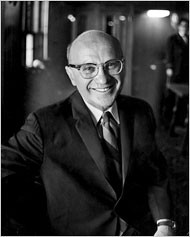
Milton Friedman, Free Markets Theorist, Dies at 94
Milton Friedman, the grandmaster of free-market economic theory in the postwar era and a prime force in the movement of nations toward less government and greater reliance on individual responsibility, died today in San Francisco, where he lived. He was 94. ...
Conservative and liberal colleagues alike viewed Mr. Friedman, a Nobel prize laureate, as one of the 20th century’s leading economic scholars, on a par with giants like John Maynard Keynes and Paul Samuelson.
Flying the flag of economic conservatism, Mr. Friedman led the postwar challenge to the hallowed theories of Lord Keynes, the British economist who maintained that governments had a duty to help capitalistic economies through periods of recession and to prevent boom times from exploding into high inflation.
In Professor Friedman’s view, government had the opposite obligation: to keep its hands off the economy, to let the free market do its work. He was a spiritual heir to Adam Smith, the 18th-century founder of the science of economics and proponent of laissez-faire: that government governs best which governs least.
The only economic lever that Mr. Friedman would allow government to use was the one that controlled the supply of money — a monetarist view that had gone out of favor when he embraced it in the 1950s. He went on to record a signal achievement, predicting the unprecedented combination of rising unemployment and rising inflation that came to be called stagflation. His work earned him the Nobel Memorial Prize in Economic Science in 1976.
Prof. Friedman was one of the great thinkers of the 20th century. Altough he is now gone, his legacy will surely last for generations to come - just as the names Adam Smith and John Maynard Keynes are still rembered.
That makes two giants of economic thought lost this year. I posted earlier this year about the loss of John Kenneth Galbraith - another great thinker.
Prior related post:
Sad News...
Wednesday, October 18, 2006
A really, really bad day...
I heard this story on the radio this morning, then found this article on MSNBC - Picasso Dream Painting in Nightmare Scenario
Ouch. Blowing up a $139MM deal with a clumsy elbow. What a bad day...
Steve Wynn ... accidentally gave the multimillion dollar [Picasso] canvas an elbow.
Wynn had just finalized a $139 million sale to another collector of his painting, called “Le Reve” (The Dream), when he poked a finger-sized hole in the artwork while showing it to friends at his Las Vegas office a couple of weeks ago.
Ouch. Blowing up a $139MM deal with a clumsy elbow. What a bad day...
Sunday, April 30, 2006
Sad News
Economist John Kenneth Galbraith dies

I realize that I have not posted in a long time. I have been extremely busy - and I have finals the next two weeks - so it's unlikely I'll be back regularly until after that. But when I saw this today, I felt the need to put something up. I have always had deep respect for Prof. Galbraith. He was one of the greatest thinkers of the 20th Century.

John Kenneth Galbraith, an influential liberal economist and author of "The Affluent Society," has died at age 97, The New York Times reported on Sunday.
The Canadian-born Galbraith, a professor at Harvard University, died on Saturday at a hospital in Cambridge, Massachusetts, the paper said.
Galbraith's most famous work, 1958's "The Affluent Society," became a bestseller. In the book, he argued that the United States had become rich in consumer goods but poor in social services.
Galbraith tutored Adlai Stevenson, the Democratic nominee for president in 1952 and 1956, on economics. He also advised President John F. Kennedy and served as his ambassador to India.
Though he eventually broke with President Lyndon Johnson over the war in Vietnam, he helped conceive of Johnson's Great Society program and wrote a major
presidential address that outlined its purposes, the Times said.
At his death Galbraith was an emeritus professor of economics at Harvard, where he had taught for most of his career.
There is also a tremendous NY Times obit - John Kenneth Galbraith, 97, Dies; Economist Held a Mirror to Society.
John Kenneth Galbraith, the iconoclastic economist, teacher and diplomat and an unapologetically liberal member of the political and academic establishment he often needled in prolific writings for more than half a century, died Saturday at a hospital in Cambridge, Mass. He was 97.
Mr. Galbraith was one of the most widely read authors in the history of economics; among his 33 books was "The Affluent Society" (1958), one of those rare works that forces a nation to re-examine its values. He wrote fluidly, even on complex topics, and many of his compelling phrases — among them "the affluent society," "conventional wisdom" and "countervailing power" — became part of the language.
An imposing presence, lanky and angular at 6 feet 8 inches tall, Mr. Galbraith was consulted frequently by national leaders, and he gave advice freely, though it may have been ignored as often as it was taken. Mr. Galbraith clearly preferred taking issue with the conventional wisdom he distrusted.
He strived to change the very texture of the national conversation about power and its nature in the modern world by explaining how the planning of giant corporations superseded market mechanisms. His sweeping ideas, which might have gained even greater traction had he developed disciples willing and able to prove them with mathematical models, came to strike some as almost quaint in today's harsh, interconnected world where corporations devour one another for breakfast.
I realize that I have not posted in a long time. I have been extremely busy - and I have finals the next two weeks - so it's unlikely I'll be back regularly until after that. But when I saw this today, I felt the need to put something up. I have always had deep respect for Prof. Galbraith. He was one of the greatest thinkers of the 20th Century.
Thursday, December 01, 2005
Keep the Promise...
Today is World Aids Day. The idea of the world-wide day of awareness is to encourage the international community to step up to the plate and fight the disease.
The theme of this World Aids Day is accountability. There will be international observances calling for nations of the world, and international organizations to keep their committmens in fighting AIDS.
Clearly, the AIDS pandemic is at its devastating worst in the poorest areas of the world. The expense of getting AIDS treatment drugs, combined with lack of proper medical facilities, labratory testing facilities, and proper basics such as nourishment and hygiene make fighting AIDS in developing portions of the world extremely difficult. But it is clearly not a lost cause.
A study to be published in the New England Journal of Medicine today reveals that a holistic approach - even in the poorest areas - can be successful. The study shows that low-cost treatment programs can dramatically increase survival rates in poor countries.
Typically only 30 percent of AIDS patients survive for one year in Haiti, the poorest country in the Western Hemisphere where the HIV infection rate is about 3 percent among adults.
But integrating drug care -- usually generic drugs -- with nutritional support, tuberculosis treatment, counseling and other public health programs brought the survival rate up to 87 percent for adults and 98 percent for children, said Fitzgerald of the Weill Medical College of Cornell University.
That is a rather staggering improvement - especially for the children. And - it's economically efficient:
Fitzgerald and his colleagues said the annual cost of giving a three-drug combination to fight the AIDS virus was about $500 for generic medicines and $750 for brand-name drugs. "We estimated the overall cost per patient per
year (including medicine) as about $1,600," they said.
If you are able to spend a paltry $1,600 and re-gain a functioning memeber of the community, who is able to go back to work...or if a child, is able to grow up and contribute to the community - that is a bargain.
But of course, the poorest regions of Africa, central America, and Asia are not the only places where there is suffering from this disease. Even here, in one of the wealthiest nations of the world, people struggle with AIDS - and at all levels, the poor, middle class, and even the wealthy. AIDS is no respecter of income. And even though many here in America are able to take advantage of drugs and treatment which enables them to live strong, vibrant lives - there still is no cure...which I was reminded of all to closely this year. Much has been done, but there is so much left to do.
A few more links:
UNAIDS
US Dept. of State
Kaiser Family Foundation
Stop AIDS. Keep the promise.
Friday, November 11, 2005
Veteran's Day...
Today is Veteran's day.
My late grandfather served in WWII. My wife's late grandfather was a navy pilot during WWII and Korea flying planes off aircraft carriers in the Pacific. My wife's father is an Air Force veteran.
 I attended a Memorial Day event earlier this year at the Veteran's cemetary here in town. Since then I've thought a lot about how quickly we are losing the "WWII Generation." If you went into the military at 18 years old in 1945 (the last year of WWII) you would be 78 this year. And if you went in in 1945, it's reasonably less likely you would have seen combat. It's not unreasonable to think that within the next 10 years the vast majority of that geneneration will have passed - along with so much of the history and connection to those times. That seems quite surreal to me.
I thought about this a lot during August and the anniversary of the bombing of Hiroshima. It's interesting to look at public perception/opinion of that event over time. In the period just after the bomb was dropped, public opinion was overwhelmingly positive and relieved. 85% supported the attack, and there was a general sense of relief that it ended the Pacific War. Polls during the 1960s showed that African- and Asian-Americans tended to oppose the strikes more than whites; and women were more uneasy with it than men. Older folks, who had more instant memories of the War, and living through the War, were still strongly supportive, but those under 30 were much more critical and uneasy with the results of the bombing. As this younger generation - the baby boom - became the leaders ... critically including the historians ... the trend increasingly became more critical and unsupportive.
I think that a lot of that shift in public perception is due to the passing of the World War II generation. Our society is losing a lot of history as this generation fades...just as the Civil War generation passed away before that, and the Founding generation before that. (And off the top of my head, I think it's safe to divide America's history into those big categories - the Founding Generation; the Civil War Generation; and the WWII Generation...which leaves me wondering what this time is we are experiencing now - the PostModern Generation???...) In this same vein, CNN is carrying an article today related to WWI vets: Time Overtaking World War I Vets It included this graphic:
I'm not sure that since the WWII generation, veteran's are looked at in the same way any more. I think there are a lot of reasons for that - we haven't had a nation galvanizing (in a positive way... or maybe more descriptive- in a threatening way) war since; the advent of modern warfare techniques have served to desanitize war to much of the public; and modern information portals mean that there is much less "mystery" about the wars as they play out. Maybe there are other factors, and better factors as well. Regardless, it doesn't seem as if the nation as a whole is as cognizant of veteran's these days.
Anyway, the point is to remember our veteran's today - the one's who sacrificed themselves to make our nation great, the one's who served to protect us and made it home, and the one's who are still "over there" fighting for us even today.
As as a part of remembering that, I want to remember the men and women whom have lost their lives during the invasion and occupation of Iraq. There have been 2,063 American casualties in the war in Iraq as of November 11, 2005. Hopefully those still there will be safely home soon.
My late grandfather served in WWII. My wife's late grandfather was a navy pilot during WWII and Korea flying planes off aircraft carriers in the Pacific. My wife's father is an Air Force veteran.
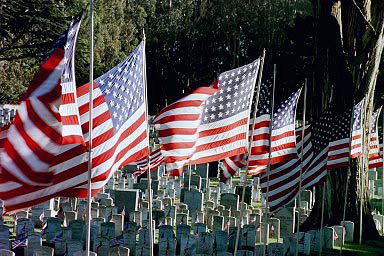 I attended a Memorial Day event earlier this year at the Veteran's cemetary here in town. Since then I've thought a lot about how quickly we are losing the "WWII Generation." If you went into the military at 18 years old in 1945 (the last year of WWII) you would be 78 this year. And if you went in in 1945, it's reasonably less likely you would have seen combat. It's not unreasonable to think that within the next 10 years the vast majority of that geneneration will have passed - along with so much of the history and connection to those times. That seems quite surreal to me.
I thought about this a lot during August and the anniversary of the bombing of Hiroshima. It's interesting to look at public perception/opinion of that event over time. In the period just after the bomb was dropped, public opinion was overwhelmingly positive and relieved. 85% supported the attack, and there was a general sense of relief that it ended the Pacific War. Polls during the 1960s showed that African- and Asian-Americans tended to oppose the strikes more than whites; and women were more uneasy with it than men. Older folks, who had more instant memories of the War, and living through the War, were still strongly supportive, but those under 30 were much more critical and uneasy with the results of the bombing. As this younger generation - the baby boom - became the leaders ... critically including the historians ... the trend increasingly became more critical and unsupportive.
I think that a lot of that shift in public perception is due to the passing of the World War II generation. Our society is losing a lot of history as this generation fades...just as the Civil War generation passed away before that, and the Founding generation before that. (And off the top of my head, I think it's safe to divide America's history into those big categories - the Founding Generation; the Civil War Generation; and the WWII Generation...which leaves me wondering what this time is we are experiencing now - the PostModern Generation???...) In this same vein, CNN is carrying an article today related to WWI vets: Time Overtaking World War I Vets It included this graphic:
VANISHING VETS
Estimated number of war-era veterans, including those outside of war zones, in civilian life as of September 30, 2005:
World War I: fewer than 50.
World War II: 3.526 million.
Korean War: 3.257 million.
Vietnam War: 8.055 million.
Desert Shield/Storm (theater only): 615,000.
Iraq/Afghanistan (theater only): 433,000.
Source: AP/Veterans Affairs Department
I'm not sure that since the WWII generation, veteran's are looked at in the same way any more. I think there are a lot of reasons for that - we haven't had a nation galvanizing (in a positive way... or maybe more descriptive- in a threatening way) war since; the advent of modern warfare techniques have served to desanitize war to much of the public; and modern information portals mean that there is much less "mystery" about the wars as they play out. Maybe there are other factors, and better factors as well. Regardless, it doesn't seem as if the nation as a whole is as cognizant of veteran's these days.
Anyway, the point is to remember our veteran's today - the one's who sacrificed themselves to make our nation great, the one's who served to protect us and made it home, and the one's who are still "over there" fighting for us even today.
As as a part of remembering that, I want to remember the men and women whom have lost their lives during the invasion and occupation of Iraq. There have been 2,063 American casualties in the war in Iraq as of November 11, 2005. Hopefully those still there will be safely home soon.
Friday, October 14, 2005
365...and counting!!!
Today marks the end of my first year of blogging. My first post was Oct. 15, 2004. I have really enjoyed this as a reposit of the things I am thinking, reading, and discussing. I haven't exactly established much of a readership of yet...is anybody out there???...but the point of this is really to record my thoughts.
So how do I mark the end of one good year of blogging? Just as any self-inflated person should: run a BEST OF...
So here are some of my favorite pieces from the past 12 months. Where do we start? Start at the very beginning, a very good place to start...
October 2004:
First Post!
And I can remember such an odd feeling - because as I was becoming a father, I remembered sitting in that old station wagon as this little kid in the 70's singing along...
Shouldn't every Lord's Day be extraordinary?... - but somewhere along the way (at least for me) it becomes everyday.
November 2004:
I love election day. ... Today is a great day - today American can take a step, even if a baby step, forward to being a better country for our grandchildren than it is for us. What a wonderful system.
Today democracy and religion engage in a bizarre dance. ... The night of celebration ends in prayer and everyone returns home full, honored and satisfied . . . except for Lazarus who remains unseen outside the gate. -Larry James
But it’s a hollow, cold victory. It’s no victory at all, if you ask me.
December 2004:
When I got Noah out of the car and he and I were walking up to the park Noah was singing/shouting over and over: Bu-bu-bue Kismus He really couldn't say blue or Christmas...but it is one of my best memories of Christmas 2004!!!
February 2005:
It was such an amazing time - and truly showed that God indeed can do anything, far above what we could even ask or imagine. It brought much of our body to tears, and it showed us once again, that God is alive...working...and blessing us with extraordinary glimpses of Him.
April 2005:
Look, we don’t always understand it, and we may not always like it, but what our judges are supposed to do is look at a set of facts, look at the law that relates to those facts, and apply that law to those facts. ... It is not these jurists “fault” for following the law if that law proves unpopular. It is their job to apply the law. Coldly.
May 2005:
Now, fortunately (for the things I believe at least), the progressive movement is starting to “get itself together” a bit. ... But in order to be successful, one has to be able to identify where you want to go and then with discipline, with rigorous preparation, and with a determined plan go there. That is my opinion at least.
There are many of us out here that are politically progressive PRECISELY because of that now-commercialized question - what would Jesus do...
[I]n my very first subject in law school, ... I finally said, "our law has to be able to provide justice." He looked at me and smirked and said, "Do you think Law has anything to do with Justice?" I meekly replied, "yes, I would hope so." He smiled and said, "Law has nothing to do with justice - and if anyone else here has such thoughts, we will beat them out of you before you leave law school." He said that and laughed, and the class laughed, and I laughed. He was joking after all...sort of.
June 2005:
On a day like today, I long to be a Constitutional Law professor. If I taught ConLaw for a living today, it would actually be my job to spend time reading and analyzing today's Supreme Court decision in Gonzales (Ashcroft) v. Raich. Unfortunately, I'm not...
I believe in a Constitution that is alive. We do not live in 1787. ... We do not live in 1787, and our Constitution is not dead.
There are many variables affecting the slide of Hollywood, but the key is that they are making putrid movies. This is why when my wife and I do head out to the movies these days, as often as not we skip the megaplex and head to the indie theatre - non-stadium seating and all, it's still a higher quality experience.
The system is wrong because it is arbitrary, because it is not justice being carried out, it is 'lightening striking.' As he sums up at the end - the death penalty is not the rule of law, it is the rule of the mob.
Frankly, I couldn't care less about some showy aparatus extolling the 10 Commandments on government property - if we don't have a government with the moral compass to step up and take responsibility for protecting our kids when it is their responsibility to do so.
July 2005:
It is time for people who love the Constitution and believe in the Bill of Rights to stand up and make their voice heard - lest we find some of our basic American rights truly put into exile.
There is no question that I'm too old. Companies named Yahoo!, products named Konfabulator which include modules called Widgets. And this is all serious!!! I can't wait for my son to get to elementary school so he can show me how to use this stuff...
August 2005:
It has never made sense to me that judges who will be running for reelection later in the year, and are facing opposition who will be promising a vengeful electorate that they are willing to be "tougher on criminals", are making life-and-death decisions in court rooms.
Well, I for one stand with Brennan. ... The beauty . . . one of the many beauties of our Constitution is that it was written broadly - to encompass the passing of time and maturing of society.
September 2005:
The situation in the city, and for the people still in there, is deteriorating every hour. ... In this day and age I would never have dreamed this could be the result.
Regardless, this case shows very specifically that the death penalty process in the United States is broken...and it cannot be fixed. There is no "fair" way to take a life. (Especially when that life is poor and black and in Texas.)
J. Blackmun dissenting - From this day forward, I no longer shall tinker with the machinery of death.
October 2005:
But it does appear that the New Federalism is a thing of the past, and traditional, Marshall-style federalism will re-emerge under the Roberts Court.
As Slate put it: You might have your own ideas, but that's the point—when you listen to a Democrat with ideas, you don't fall into a deep funk or get hungry again half an hour later.
Instead of slowly phasing out the idea of TIRZs completely, my proposal would allow for more neighborhoods, and neighborhoods in greater need to benefit from the program - which would bring more benefit to Houston long-term.
Hopefully, there will be much more to come during the next year.
Happy anniversary to Famous Last Words...
So how do I mark the end of one good year of blogging? Just as any self-inflated person should: run a BEST OF...
So here are some of my favorite pieces from the past 12 months. Where do we start? Start at the very beginning, a very good place to start...
October 2004:
First Post!
And I can remember such an odd feeling - because as I was becoming a father, I remembered sitting in that old station wagon as this little kid in the 70's singing along...
Shouldn't every Lord's Day be extraordinary?... - but somewhere along the way (at least for me) it becomes everyday.
November 2004:
I love election day. ... Today is a great day - today American can take a step, even if a baby step, forward to being a better country for our grandchildren than it is for us. What a wonderful system.
Today democracy and religion engage in a bizarre dance. ... The night of celebration ends in prayer and everyone returns home full, honored and satisfied . . . except for Lazarus who remains unseen outside the gate. -Larry James
But it’s a hollow, cold victory. It’s no victory at all, if you ask me.
December 2004:
When I got Noah out of the car and he and I were walking up to the park Noah was singing/shouting over and over: Bu-bu-bue Kismus He really couldn't say blue or Christmas...but it is one of my best memories of Christmas 2004!!!
February 2005:
It was such an amazing time - and truly showed that God indeed can do anything, far above what we could even ask or imagine. It brought much of our body to tears, and it showed us once again, that God is alive...working...and blessing us with extraordinary glimpses of Him.
April 2005:
Look, we don’t always understand it, and we may not always like it, but what our judges are supposed to do is look at a set of facts, look at the law that relates to those facts, and apply that law to those facts. ... It is not these jurists “fault” for following the law if that law proves unpopular. It is their job to apply the law. Coldly.
May 2005:
Now, fortunately (for the things I believe at least), the progressive movement is starting to “get itself together” a bit. ... But in order to be successful, one has to be able to identify where you want to go and then with discipline, with rigorous preparation, and with a determined plan go there. That is my opinion at least.
There are many of us out here that are politically progressive PRECISELY because of that now-commercialized question - what would Jesus do...
[I]n my very first subject in law school, ... I finally said, "our law has to be able to provide justice." He looked at me and smirked and said, "Do you think Law has anything to do with Justice?" I meekly replied, "yes, I would hope so." He smiled and said, "Law has nothing to do with justice - and if anyone else here has such thoughts, we will beat them out of you before you leave law school." He said that and laughed, and the class laughed, and I laughed. He was joking after all...sort of.
June 2005:
On a day like today, I long to be a Constitutional Law professor. If I taught ConLaw for a living today, it would actually be my job to spend time reading and analyzing today's Supreme Court decision in Gonzales (Ashcroft) v. Raich. Unfortunately, I'm not...
I believe in a Constitution that is alive. We do not live in 1787. ... We do not live in 1787, and our Constitution is not dead.
There are many variables affecting the slide of Hollywood, but the key is that they are making putrid movies. This is why when my wife and I do head out to the movies these days, as often as not we skip the megaplex and head to the indie theatre - non-stadium seating and all, it's still a higher quality experience.
The system is wrong because it is arbitrary, because it is not justice being carried out, it is 'lightening striking.' As he sums up at the end - the death penalty is not the rule of law, it is the rule of the mob.
Frankly, I couldn't care less about some showy aparatus extolling the 10 Commandments on government property - if we don't have a government with the moral compass to step up and take responsibility for protecting our kids when it is their responsibility to do so.
July 2005:
It is time for people who love the Constitution and believe in the Bill of Rights to stand up and make their voice heard - lest we find some of our basic American rights truly put into exile.
There is no question that I'm too old. Companies named Yahoo!, products named Konfabulator which include modules called Widgets. And this is all serious!!! I can't wait for my son to get to elementary school so he can show me how to use this stuff...
August 2005:
It has never made sense to me that judges who will be running for reelection later in the year, and are facing opposition who will be promising a vengeful electorate that they are willing to be "tougher on criminals", are making life-and-death decisions in court rooms.
Well, I for one stand with Brennan. ... The beauty . . . one of the many beauties of our Constitution is that it was written broadly - to encompass the passing of time and maturing of society.
September 2005:
The situation in the city, and for the people still in there, is deteriorating every hour. ... In this day and age I would never have dreamed this could be the result.
Regardless, this case shows very specifically that the death penalty process in the United States is broken...and it cannot be fixed. There is no "fair" way to take a life. (Especially when that life is poor and black and in Texas.)
J. Blackmun dissenting - From this day forward, I no longer shall tinker with the machinery of death.
October 2005:
But it does appear that the New Federalism is a thing of the past, and traditional, Marshall-style federalism will re-emerge under the Roberts Court.
As Slate put it: You might have your own ideas, but that's the point—when you listen to a Democrat with ideas, you don't fall into a deep funk or get hungry again half an hour later.
Instead of slowly phasing out the idea of TIRZs completely, my proposal would allow for more neighborhoods, and neighborhoods in greater need to benefit from the program - which would bring more benefit to Houston long-term.
Hopefully, there will be much more to come during the next year.
Happy anniversary to Famous Last Words...
Friday, August 26, 2005
Great quote...
From Slate:
Reality TV is not even a guilty pleasure anymore. It's as if our entire culture has reached the halfway point in a gigantic bag of Cheetos and just collectively decided to go ahead and finish it off.Sad but true...
Tuesday, July 26, 2005
I am really getting to old...
I honestly don't know if this is serious technology reporting...or satire.
An acquisition by Yahoo empowers widget market
There is no question that I'm too old. Companies named Yahoo!, products named Konfabulator which include modules called Widgets. And this is all serious!!! I can't wait for my son to get to elementary school so he can show me how to use this stuff...
An acquisition by Yahoo empowers widget market
Konfabulator is a Java-based program that runs modules called widgets. Each widget specializes in fetching specific information and displaying it on a computer desktop in a visually cool way.
Normally, I'm suspicious when a small, innovative company is swallowed by a bigger one, but given that Yahoo has made the program free and taken Pixoria's entire three-person staff on as employees, there's not much of a downside. The only evil I can see so far is that the name's been changed to — ugh — Yahoo! Widgets.
Other than the fact that Konfabulator's cool, free and incredibly useful, why is this an important move by Yahoo?
Most of the widgets developed for Konfabulator rely on a kind of data feed known as XML, which stands for Extensible Markup Language. This is the code that powers RSS, or Really Simple Syndication feeds, which I have written about in the past (see www.chron.com/rssreaders).
Konfabulator allows widget designers to capture XML feeds and present them graphically, rather than as simple text or a table. That's important for the development of this powerful technology, which is primarily used now by techies and early adopters. Konfabulator is the type of application that can bring RSS and XML to the masses. And that's Yahoo's audience.
With its abundance of content and marketing savvy, Yahoo could turn Konfabulator into a killer application.
There is no question that I'm too old. Companies named Yahoo!, products named Konfabulator which include modules called Widgets. And this is all serious!!! I can't wait for my son to get to elementary school so he can show me how to use this stuff...
Wednesday, May 25, 2005
An economics detective story.
Absolutely fascinating and compellingly intertwined piece from Slate. (Credit to Volokh, where I first saw this here.)
The Search for 100 Million Missing Women
This article is interesting enough on its face - the story of how an economist is using data to "find" about 50MM of Amartya Sen's 100MM 'missing women' in southeast Asia. But, it takes an almost surreal twist at the end when the demographic study intertwines with an earlier phsycological study of toddlers - it gets wild.
This is great stuff - intersting and informative, and a story that is almost too good to believe. Read this, and tell me you don't double take at the last paragraph...
The Search for 100 Million Missing Women
This article is interesting enough on its face - the story of how an economist is using data to "find" about 50MM of Amartya Sen's 100MM 'missing women' in southeast Asia. But, it takes an almost surreal twist at the end when the demographic study intertwines with an earlier phsycological study of toddlers - it gets wild.
This is great stuff - intersting and informative, and a story that is almost too good to believe. Read this, and tell me you don't double take at the last paragraph...
Thursday, May 12, 2005
Crime Doesn't Pay
Well, I became the victim of a crime last night for the first time ever (if you don't include the money I lost on Enron stock).
My car was broken into. Whomever the poor soul was who did it must have been sorely disappointed only to rummage through a car with nothing but a few CD's and a ton of little boys toys.
The culprit was actually pretty considerate - they left my work badge, my downtown parking pass, my school parking pass, and all the insurance, etc. info from my glove compartment. It looks as if they were simply rummaging for some cash. They did take a handful of CDs - but anyone who is so desperate as to take off with an Uncle Tupelo, Pearl Jam, Damnations, Slobberbone, and Wilco CDs probably needs them a whole lot worse than I. Frankly, I can only hope they are of good use to the individual. She or he was kind enough to leave my boy's Disney and Veggie Tales CDs sitting on the front seat - I guess that just wasn't their style.
Not exactly a scintilating story for my first crime experienced living in downtown Houston - but hey, I'd prefer to never have another one if I can help it.
I'm still a lot more bitter about those criminals at Enron...
My car was broken into. Whomever the poor soul was who did it must have been sorely disappointed only to rummage through a car with nothing but a few CD's and a ton of little boys toys.
The culprit was actually pretty considerate - they left my work badge, my downtown parking pass, my school parking pass, and all the insurance, etc. info from my glove compartment. It looks as if they were simply rummaging for some cash. They did take a handful of CDs - but anyone who is so desperate as to take off with an Uncle Tupelo, Pearl Jam, Damnations, Slobberbone, and Wilco CDs probably needs them a whole lot worse than I. Frankly, I can only hope they are of good use to the individual. She or he was kind enough to leave my boy's Disney and Veggie Tales CDs sitting on the front seat - I guess that just wasn't their style.
Not exactly a scintilating story for my first crime experienced living in downtown Houston - but hey, I'd prefer to never have another one if I can help it.
I'm still a lot more bitter about those criminals at Enron...
Monday, May 02, 2005
A bit of Reading...
A few of the more interesting pieces of web reading I've done recently:
Legal Education as a Training for Hierarchy
by Duncan Kennedy
Duncan Kennedy is the Carter Professor of General Jurisprudence at Harvard Law School. Kennedy clerked for Justice Potter Stewart at the Supreme Court for a year and has since been at Harvard. Kennedy is at the forefront of the Critical Legal Studies movement. CLS is a no longer popular theory of law as simply rules and institutions tilted toward protection of the interests of wealth, property and power, thus biased against the poor, working classes, women, and minorities. This particular piece is less concerned with the overarching details of CLS. It is an essay on how the field of law hierarchal, and that law schools perpetuate, and indeed force that hierarchy with they way that they structure legal education.
Hugo Chavez and Petro Populism
by Christian Parenti for The Nation
Opinions vary wildly about Hugo Chavez and what he is doing in Venezuela. The general reaction by United States is one of distain (the US allegedly participated in the coup against him in 2002). As a military leader, Chavez led a failed military coup in 1992 and spent two years in prison. Chavez came back as a politician, organizing a new party and was elected President in 1998. The coup of 2002 proved unsuccessful and he regained power, and survived a removal referendum in 2003. Now, Chavez is embarking upon, "building a socialism for the twenty-first century" in Venezuela through Land and Oil initiatives. This article chronicles some of those political reforms.
The Brains Behind Blackmun
David J. Garrow for Legal Affairs
David Garrow is professor of law at Emory University. In this scathing article, Garrow accuses Justice Harry Blackmun of a "scandalous abdication of judicial responsibility." This article is the culimination of Garrow's examination of Blackmun's papers, made public since his death. This article pulls no punches - but to me it seems unpersuasive. The anecdotes and 'memo notes' that Garrow relies upon to make his extreme accusations seem much less than advertised - you have to do a tremendous amount of 'reading-into' the words/stories to make it as extreme as Garrow does. It is, however, an engaging piece, and it is stirring a lot of feathers. In addition, opposing responses from the Chairman of Legal Affairs and two of Blackmun's clerks can be found here.
Psst, Wanna Buy My Skyscraper?
by Daniel Gross for Slate
Interesting piece about how many large corporations have recently been divesting thier skyscraper corporate headquarters buildings. In such a time of booming real estate markets, that seems an odd coincidence. Is this an advanced warning of the burstsing of the real estate bubble? Or simply company's capitalizing on the current market and taking their gains while they can?
The Unregulated Offensive (pay)
by Jeffrey Rosen for The New York Times
Jeffrey Rosen is a law professor at George Washington University. This piece examines the "Constitution-in-Exile" movement. This is a movement of conservatives who (in a synopsis) believe that the US Constitution has been in exile since 1937 when the Supreme Court began approving the New Deal programs. Essentially, they promote a return to pre-1937 Constitutional Law - which of course is a return to Freedom of Conract, Segregation, etc. There is an interesting debate going on as to whether there really is a Constitution-in-Exile movement, or if it is simply a framing by left leading academians to negatively portray the reactionary right. An interesting debate will be going on at the Legal Affairs Debate Club this week about Constitution-in-Exile.
Legal Education as a Training for Hierarchy
by Duncan Kennedy
Duncan Kennedy is the Carter Professor of General Jurisprudence at Harvard Law School. Kennedy clerked for Justice Potter Stewart at the Supreme Court for a year and has since been at Harvard. Kennedy is at the forefront of the Critical Legal Studies movement. CLS is a no longer popular theory of law as simply rules and institutions tilted toward protection of the interests of wealth, property and power, thus biased against the poor, working classes, women, and minorities. This particular piece is less concerned with the overarching details of CLS. It is an essay on how the field of law hierarchal, and that law schools perpetuate, and indeed force that hierarchy with they way that they structure legal education.
Hugo Chavez and Petro Populism
by Christian Parenti for The Nation
Opinions vary wildly about Hugo Chavez and what he is doing in Venezuela. The general reaction by United States is one of distain (the US allegedly participated in the coup against him in 2002). As a military leader, Chavez led a failed military coup in 1992 and spent two years in prison. Chavez came back as a politician, organizing a new party and was elected President in 1998. The coup of 2002 proved unsuccessful and he regained power, and survived a removal referendum in 2003. Now, Chavez is embarking upon, "building a socialism for the twenty-first century" in Venezuela through Land and Oil initiatives. This article chronicles some of those political reforms.
The Brains Behind Blackmun
David J. Garrow for Legal Affairs
David Garrow is professor of law at Emory University. In this scathing article, Garrow accuses Justice Harry Blackmun of a "scandalous abdication of judicial responsibility." This article is the culimination of Garrow's examination of Blackmun's papers, made public since his death. This article pulls no punches - but to me it seems unpersuasive. The anecdotes and 'memo notes' that Garrow relies upon to make his extreme accusations seem much less than advertised - you have to do a tremendous amount of 'reading-into' the words/stories to make it as extreme as Garrow does. It is, however, an engaging piece, and it is stirring a lot of feathers. In addition, opposing responses from the Chairman of Legal Affairs and two of Blackmun's clerks can be found here.
Psst, Wanna Buy My Skyscraper?
by Daniel Gross for Slate
Interesting piece about how many large corporations have recently been divesting thier skyscraper corporate headquarters buildings. In such a time of booming real estate markets, that seems an odd coincidence. Is this an advanced warning of the burstsing of the real estate bubble? Or simply company's capitalizing on the current market and taking their gains while they can?
The Unregulated Offensive (pay)
by Jeffrey Rosen for The New York Times
Jeffrey Rosen is a law professor at George Washington University. This piece examines the "Constitution-in-Exile" movement. This is a movement of conservatives who (in a synopsis) believe that the US Constitution has been in exile since 1937 when the Supreme Court began approving the New Deal programs. Essentially, they promote a return to pre-1937 Constitutional Law - which of course is a return to Freedom of Conract, Segregation, etc. There is an interesting debate going on as to whether there really is a Constitution-in-Exile movement, or if it is simply a framing by left leading academians to negatively portray the reactionary right. An interesting debate will be going on at the Legal Affairs Debate Club this week about Constitution-in-Exile.
Tuesday, November 09, 2004
The Wit and Wisdom of TR
I have come to really admire a lot about Teddy Roosevelt. I'm sure that there are a hundred things which I wouldn't agree with him, but I'd consider him much of what I'm looking for in a leader of our nation. A true Progressive. I was recently looking at some quotes by TR, and I thought I'd share some here (my favorites in bold):
To announce that there must be no criticism of the president, or that we are to stand by the president right or wrong, is not only unpatriotic and servile, but is morally treasonable to the American public.
– Theodore Roosevelt
To waste, to destroy, our natural resources, to skin and exhaust the land instead of using it so as to increase its usefulness, will result in undermining in the days of our children the very prosperity which we ought by right to hand down to them amplified and developed.
– Theodore Roosevelt, Seventh Annual Message to U.S. Congress (December 3, 1907)
Unrestrained greed means the ruin of the great woods and the drying up of the sources of the rivers.
– Theodore Roosevelt, on clear-cutting of forests, while governor of New York, quoted in his biography Theodore Rex by Edmund Morris (2001)
We demand that big business give the people a square deal; in return we must insist that when anyone engaged in big business honestly endeavors to do right he shall himself be given a square deal.
– Theodore Roosevelt
Whenever you are asked if you can do a job, tell 'em, "Certainly, I can!" Then get busy and find out how to do it.
– Theodore Roosevelt
Those who oppose all reform will do well to remember that ruin in its worst form is inevitable if our national life brings us nothing better than swollen fortunes for the few and the triumph in both politics and business of a sordid and selfish materialism.
– Theodore Roosevelt, speech at Osawatomie, Kansas, "The New Nationalism" (August 31, 1910)
The true friend of property, the true conservative, is he who insists that property shall be the servant and not the master of the commonwealth; who insists that the creature of man's making shall be the servant and not the master of the man who made it. The citizens of the United States must effectively control the mighty commercial forces which they have themselves called into being.
– Theodore Roosevelt, speech at Osawatomie, Kansas, "The New Nationalism" (August 31, 1910)
The one thing I want to leave my children is an honorable name.
– Theodore Roosevelt
The only man who never makes a mistake is the man who never does anything.
– Theodore Roosevelt
The nation behaves well if it treats the natural resources as assets which it must turn over to the next generation increased, and not impaired, in value.
– Theodore Roosevelt
The old parties are husks, with no real soul within either, divided on artificial lines, boss-ridden and privilege-controlled, each a jumble of incongruous elements, and neither daring to speak out wisely and fearlessly on what should be said on the vital issues of the day.
– Theodore Roosevelt, speech at the Progressive Party Convention, Chicago, Illinois (August 6, 1912)
The most important single ingredient in the formula of success is knowing how to get along with people.
– Theodore Roosevelt
The men of wealth who today are trying to prevent the regulation and control of their business in the interest of the public by the proper government authorities will not succeed, in my judgment, in checking the progress of the movement. But if they did succeed they would find that they had sown the wind and would surely reap the whirlwind, for they would ultimately provoke the violent excesses which accompany a reform coming by convulsion instead of by steady and natural growth.
– Theodore Roosevelt, speech, "The Man With The Muck Rake" (April 15, 1906)
The first requisite of a good citizen in this republic of ours is that he shall be able and willing to pull his weight.
– Theodore Roosevelt, speech at New York City (November 11, 1902)
The government is us; we are the government, you and I.
– Theodore Roosevelt, speech at Asheville, North Carolina (September 9, 1902)
The absence of effective State, and, especially, national, restraint upon unfair money-getting has tended to create a small class of enormously wealthy and economically powerful men, whose chief object is to hold and increase their power. The prime need is to change the conditions which enable these men to accumulate power which is not for the general welfare that they should hold or exercise. We grudge no man a fortune which represents his own power and sagacity, when exercised with entire regard to the welfare of his fellows.
– Theodore Roosevelt, speech at Osawatomie, Kansas, "The New Nationalism" (August 31, 1910)
Probably the greatest harm done by vast wealth is the harm that we of moderate means do ourselves when we let the vices of envy and hatred enter deep into our own natures.
– Theodore Roosevelt, speech at Providence, Rhode Island (August 23, 1902)
One of the fundamental necessities in a representative government such as ours is to make certain that the men to whom the people delegate their power shall serve the people by whom they are elected, and not the special interests. I believe that every national officer, elected or appointed, should be forbidden to perform any service or receive any compensation, directly or indirectly, from interstate corporations; and a similar provision could not fail to be useful within the States.
– Theodore Roosevelt, speech at Osawatomie, Kansas, "The New Nationalism" (August 31, 1910)
No man is above the law and no man is below it; nor do we ask any man's permission when we require him to obey it. Obedience to the law is demanded as a right; not asked as a favor.
– Theodore Roosevelt (December 7, 1903)
No man can be a good citizen unless he has a wage more than sufficient to cover the bare cost of living, and hours of labor short enough so that after his day's work is done he will have time and energy to bear his share in the management of the community, to help in carrying the general load. We keep countless men from being good citizens by the conditions of life with which we surround them. We need comprehensive workmen's compensation acts, both State and national laws to regulate child labor and work for women, and, especially, we need in our common schools not merely education in booklearning, but also practical training for daily life and work. We need to enforce better sanitary conditions for our workers and to extend the use of safety appliances for our workers in industry and commerce, both within and between the States.
– Theodore Roosevelt, speech at Osawatomie, Kansas, "The New Nationalism" (August 31, 1910)
It is essential that there should be organization of labor. This is an era of organization. Capital organizes and therefore labor must organize.
– Theodore Roosevelt, speech at Milwaukee, Wisconsin (October 14, 1912)
It is hard to fail, but it is worse never to have tried to succeed. In this life we get nothing save by effort.
– Theodore Roosevelt
It is better to be faithful than famous.
– Theodore Roosevelt
In name we had the Declaration of Independence in 1776; but we gave the lie by our acts to the words of the Declaration of Independence until 1865; and words count for nothing except in so far as they represent acts.
– Theodore Roosevelt, speech at Osawatomie, Kansas, "The New Nationalism" (August 31, 1910)
In any moment of decision, the best thing you can do is the right thing. The worst thing you can do is nothing.
– Theodore Roosevelt
I am only an average man but, by George, I work harder at it than the average man.
– Theodore Roosevelt
I believe that the officers, and, especially, the directors, of corporations should be held personally responsible when any corporation breaks the law.
– Theodore Roosevelt, speech at Osawatomie, Kansas, "The New Nationalism" (August 31, 1910)
I care not what others think of what I do, but I care very much about what I think of what I do. That is character!
– Theodore Roosevelt
I have always been fond of the West African proverb: "Speak softly and carry a big stick; you will go far."
– Theodore Roosevelt
Every reform movement has a lunatic fringe.
– Theodore Roosevelt (1913)
Don't hit at all if it is honorably possible to avoid hitting; but never hit soft.
– Theodore Roosevelt
A man who is good enough to shed his blood for his country is good enough to be given a square deal afterwards.
– Theodore Roosevelt, speech at Springfield, Illinois (July 4, 1903)
A typical vice of American politics is the avoidance of saying anything real on real issues.
– Theodore Roosevelt
Americanism is a question of principle, of purpose, of idealism, or character; it is not a matter of birthplace or creed or line of descent.
– Theodore Roosevelt, speech at Washington, DC (1909)
To announce that there must be no criticism of the president, or that we are to stand by the president right or wrong, is not only unpatriotic and servile, but is morally treasonable to the American public.
– Theodore Roosevelt
To waste, to destroy, our natural resources, to skin and exhaust the land instead of using it so as to increase its usefulness, will result in undermining in the days of our children the very prosperity which we ought by right to hand down to them amplified and developed.
– Theodore Roosevelt, Seventh Annual Message to U.S. Congress (December 3, 1907)
Unrestrained greed means the ruin of the great woods and the drying up of the sources of the rivers.
– Theodore Roosevelt, on clear-cutting of forests, while governor of New York, quoted in his biography Theodore Rex by Edmund Morris (2001)
We demand that big business give the people a square deal; in return we must insist that when anyone engaged in big business honestly endeavors to do right he shall himself be given a square deal.
– Theodore Roosevelt
Whenever you are asked if you can do a job, tell 'em, "Certainly, I can!" Then get busy and find out how to do it.
– Theodore Roosevelt
Those who oppose all reform will do well to remember that ruin in its worst form is inevitable if our national life brings us nothing better than swollen fortunes for the few and the triumph in both politics and business of a sordid and selfish materialism.
– Theodore Roosevelt, speech at Osawatomie, Kansas, "The New Nationalism" (August 31, 1910)
The true friend of property, the true conservative, is he who insists that property shall be the servant and not the master of the commonwealth; who insists that the creature of man's making shall be the servant and not the master of the man who made it. The citizens of the United States must effectively control the mighty commercial forces which they have themselves called into being.
– Theodore Roosevelt, speech at Osawatomie, Kansas, "The New Nationalism" (August 31, 1910)
The one thing I want to leave my children is an honorable name.
– Theodore Roosevelt
The only man who never makes a mistake is the man who never does anything.
– Theodore Roosevelt
The nation behaves well if it treats the natural resources as assets which it must turn over to the next generation increased, and not impaired, in value.
– Theodore Roosevelt
The old parties are husks, with no real soul within either, divided on artificial lines, boss-ridden and privilege-controlled, each a jumble of incongruous elements, and neither daring to speak out wisely and fearlessly on what should be said on the vital issues of the day.
– Theodore Roosevelt, speech at the Progressive Party Convention, Chicago, Illinois (August 6, 1912)
The most important single ingredient in the formula of success is knowing how to get along with people.
– Theodore Roosevelt
The men of wealth who today are trying to prevent the regulation and control of their business in the interest of the public by the proper government authorities will not succeed, in my judgment, in checking the progress of the movement. But if they did succeed they would find that they had sown the wind and would surely reap the whirlwind, for they would ultimately provoke the violent excesses which accompany a reform coming by convulsion instead of by steady and natural growth.
– Theodore Roosevelt, speech, "The Man With The Muck Rake" (April 15, 1906)
The first requisite of a good citizen in this republic of ours is that he shall be able and willing to pull his weight.
– Theodore Roosevelt, speech at New York City (November 11, 1902)
The government is us; we are the government, you and I.
– Theodore Roosevelt, speech at Asheville, North Carolina (September 9, 1902)
The absence of effective State, and, especially, national, restraint upon unfair money-getting has tended to create a small class of enormously wealthy and economically powerful men, whose chief object is to hold and increase their power. The prime need is to change the conditions which enable these men to accumulate power which is not for the general welfare that they should hold or exercise. We grudge no man a fortune which represents his own power and sagacity, when exercised with entire regard to the welfare of his fellows.
– Theodore Roosevelt, speech at Osawatomie, Kansas, "The New Nationalism" (August 31, 1910)
Probably the greatest harm done by vast wealth is the harm that we of moderate means do ourselves when we let the vices of envy and hatred enter deep into our own natures.
– Theodore Roosevelt, speech at Providence, Rhode Island (August 23, 1902)
One of the fundamental necessities in a representative government such as ours is to make certain that the men to whom the people delegate their power shall serve the people by whom they are elected, and not the special interests. I believe that every national officer, elected or appointed, should be forbidden to perform any service or receive any compensation, directly or indirectly, from interstate corporations; and a similar provision could not fail to be useful within the States.
– Theodore Roosevelt, speech at Osawatomie, Kansas, "The New Nationalism" (August 31, 1910)
No man is above the law and no man is below it; nor do we ask any man's permission when we require him to obey it. Obedience to the law is demanded as a right; not asked as a favor.
– Theodore Roosevelt (December 7, 1903)
No man can be a good citizen unless he has a wage more than sufficient to cover the bare cost of living, and hours of labor short enough so that after his day's work is done he will have time and energy to bear his share in the management of the community, to help in carrying the general load. We keep countless men from being good citizens by the conditions of life with which we surround them. We need comprehensive workmen's compensation acts, both State and national laws to regulate child labor and work for women, and, especially, we need in our common schools not merely education in booklearning, but also practical training for daily life and work. We need to enforce better sanitary conditions for our workers and to extend the use of safety appliances for our workers in industry and commerce, both within and between the States.
– Theodore Roosevelt, speech at Osawatomie, Kansas, "The New Nationalism" (August 31, 1910)
It is essential that there should be organization of labor. This is an era of organization. Capital organizes and therefore labor must organize.
– Theodore Roosevelt, speech at Milwaukee, Wisconsin (October 14, 1912)
It is hard to fail, but it is worse never to have tried to succeed. In this life we get nothing save by effort.
– Theodore Roosevelt
It is better to be faithful than famous.
– Theodore Roosevelt
In name we had the Declaration of Independence in 1776; but we gave the lie by our acts to the words of the Declaration of Independence until 1865; and words count for nothing except in so far as they represent acts.
– Theodore Roosevelt, speech at Osawatomie, Kansas, "The New Nationalism" (August 31, 1910)
In any moment of decision, the best thing you can do is the right thing. The worst thing you can do is nothing.
– Theodore Roosevelt
I am only an average man but, by George, I work harder at it than the average man.
– Theodore Roosevelt
I believe that the officers, and, especially, the directors, of corporations should be held personally responsible when any corporation breaks the law.
– Theodore Roosevelt, speech at Osawatomie, Kansas, "The New Nationalism" (August 31, 1910)
I care not what others think of what I do, but I care very much about what I think of what I do. That is character!
– Theodore Roosevelt
I have always been fond of the West African proverb: "Speak softly and carry a big stick; you will go far."
– Theodore Roosevelt
Every reform movement has a lunatic fringe.
– Theodore Roosevelt (1913)
Don't hit at all if it is honorably possible to avoid hitting; but never hit soft.
– Theodore Roosevelt
A man who is good enough to shed his blood for his country is good enough to be given a square deal afterwards.
– Theodore Roosevelt, speech at Springfield, Illinois (July 4, 1903)
A typical vice of American politics is the avoidance of saying anything real on real issues.
– Theodore Roosevelt
Americanism is a question of principle, of purpose, of idealism, or character; it is not a matter of birthplace or creed or line of descent.
– Theodore Roosevelt, speech at Washington, DC (1909)
Subscribe to:
Posts (Atom)


