I have not posted in a couple of weeks now. If I had any sort of a regular readership, I'd probably be worried about that...but the past weeks have been very busy with the combination of finals, gearing up for the holidays, a really tremendous legal opportunity, and the end of my employment and accounting career.
But, in the midst of all that, last week was ONE GREAT WEEK. I've resigned my job, and will no longer be working as an accountant - but will be going to school full-time, along with several school projects on the side, and an exciting opportunity to get some actual experience. I finished up with my finals for Fall 2005. And - probably most exciting:
HOUSTON HAS AN MLS TEAM!!!!!!!!!!!!!!!!!!!!!
Wonderful. Here is the website:
MLS Houston
Exciting developments. The (as yet un-named) team will play at Robertson Stadium on the campus of the University of Houston...and it is not an expansion team. The former San Jose Earthquakes are re-locating - so this is a team stocked with talent, and that finished first in the Western Division standings last year, and won MLS Cup two of the past five.
Quite a Christmas present, huh? Yes, more 'important' things have been going on the past two weeks - but this was mighty exciting to me.
Tuesday, December 20, 2005


Wednesday, December 07, 2005
Politics of death...
This story is another example of why capital punishment in America is wholly unjust and arbitrary - and is simply unjustified.
The story of Tookie Williams is pretty well know these days. Founder of a notorious gang (the Crips) convicted of four murders, but now while on death row, he has become a leading anti-gang activist and is credited by many former gang members as being the reason for them getting out of the gang lifestyle.
Does that 'conversion' merit the clemency of his sentence of death? I don't know. Obviously I tend to think so - but I'm not convinced that capital punishment works to begin with. Regardless of if he "deserves" clemency, the reason why Williams' case is a textbook example of the arbitrariness and illegitimacy of the death penalty is this:
I do not know Tookie Williams. I do not know if he committed the heinous crimes he has been convicted of. I do not know if his anti-gang work while on death row is a result of true repentance and conversion, or simply an effort to save his own life.
But I do know that the life and death of a human being - a human being named Tookie Williams - is likely going to be determined more by polls and politics than justice. I do know that is shameful.
Other capital punishment posts:
The wise words of Harry Blackmun...
An incredibly sad textbook example...
Stevens: 'Serious flaws' in death penalty
Believe it or not...
Go buy this book...
Capital Punishment in Texas...
Will Texas lose the death penalty?
Lethal Injustice...
Software Models Capital Punishment Outcomes
The story of Tookie Williams is pretty well know these days. Founder of a notorious gang (the Crips) convicted of four murders, but now while on death row, he has become a leading anti-gang activist and is credited by many former gang members as being the reason for them getting out of the gang lifestyle.
Does that 'conversion' merit the clemency of his sentence of death? I don't know. Obviously I tend to think so - but I'm not convinced that capital punishment works to begin with. Regardless of if he "deserves" clemency, the reason why Williams' case is a textbook example of the arbitrariness and illegitimacy of the death penalty is this:
"Clemency has become part of the politics of criminal punishment and has been slowly evaporating," said Frank Zimring, a clemency expert at the University of California at Berkeley. "When it comes to crime and punishment, there's been a conspicuous toughening of the governor and the public."
....
Schwarzenegger is still smarting from the defeat of four ballot measures he backed during a November special election, and political analysts have said that granting clemency would not sit well with the conservative base the Republican needs if he hopes to win re-election next year.
An independent poll last year found that 68 percent of Californians support the death penalty -- 54 percent of Democrats and 87 percent of Republicans.
"If he granted clemency, I would say, it would be a very divisive opinion," pollster Mark DiCamillo said. "Large segments of the public would take him to task."
I do not know Tookie Williams. I do not know if he committed the heinous crimes he has been convicted of. I do not know if his anti-gang work while on death row is a result of true repentance and conversion, or simply an effort to save his own life.
But I do know that the life and death of a human being - a human being named Tookie Williams - is likely going to be determined more by polls and politics than justice. I do know that is shameful.
Other capital punishment posts:
The wise words of Harry Blackmun...
An incredibly sad textbook example...
Stevens: 'Serious flaws' in death penalty
Believe it or not...
Go buy this book...
Capital Punishment in Texas...
Will Texas lose the death penalty?
Lethal Injustice...
Software Models Capital Punishment Outcomes
Friday, December 02, 2005

Thursday, December 01, 2005
Harry Potter spoiler alert...
SPOILER ALERT
 This week I finished reading the latest in the Harry Potter series of books - Harry Potter and the Half-Blood Prince.
I was fortunate to be able to get this in over the Thanksgiving holiday - now that I'm in school I very rarely have much time for reading for pleasure. I borrowed Half-Blood Prince from a friend and was about 100 pages into it, a week or so ago, but I was totally lost. There were characters and story lines being referenced which I had absolutely no recognition of. So, then I decided that I needed to go back and read
Harry Potter and the Order of the Pheonix again, because I literally did not remember a thing about that book. That is kind of a scary proposition - the fact that you have read a book before and could not remember a single event, character or plot twist only a year or two later. I console myself thinking about how the thousands of pages of legal cases I've read since then has simply pushed these stories from my mind...but I'm really just worried I'm getting old.
Well, if you've read Half-Blood Prince, you know there are some - shall we say - twists and turns, or surprises in store. Well, I want to talk about some of those surprises a little bit in this post...
So, WARNING - PLOT SPOILERS AHEAD.
If you have not read Half-Blood Prince, but intend on doing so, please stop reading this now - because I am going to write about somethings that happen that you will not want to know before you read. If you do not want to spoil the plot of Half-Blood Prince stop reading now.
Also, WARNING - FUTURE PLOT CONJECTURE AHEAD.
The purpose of this post is I have some ideas kicking around in my head about something that may happen in the seventh and final installment of the Harry Potter books - and if I'm right, it may well not surprise you as much when you read that book. So, if you do not want to face the possibility of a surprise of Book 7 potentially being revealed here, stop reading now.
SPOILER ALERT

Okay, as I mentioned, after reading Half-Blood Prince, I got to thinking about the ending, and something came to me that might be an important part of the final book - and I want to record that here so that, in two years when the final book comes out, I can verify if I was correct or not. I do want to add here - I do not read Harry Potter websites - so if this is a very common theory of what is happening in the books, then I apologize for not citing those sources, but this comes simply from my thoughts about the books, not anything external I've read.
SPOILER ALERT
As you know if you have read Half-Blood Prince, Professor Dumbeldore (Hogwarts Headmaster, and mentor/protector of Harry Potter) dies toward the end of the book. That was a bit of a surprise - not completely, but to some extent. What was much more surprising to me was the source of his death - he was killed by the killing curse by none other than Hogwarts Professor Severus Snape. Snape is a former Death Eater, who had turned spy for the Order of the Pheonix (those whom fight the antagonist in the books - Lord Voldemort). But many in the Order - if not all other than Dumbledore - still did not trust Snape. They felt he was still too entwined in the Dark Arts, and was really still a follower of Voldemort. But Dumbledore steadfastly trusted Snape, and refused to listen to anyone's doubts of Snape's pure loyalty.
And yet it was Snape who administered the curse which killed Dumbledore.
What to make of this. Well, clearly, the idea from the book is that Harry and the other members of the Order were correct all along about Snape - that he was still evil, still following Voldemort, and that Dumbledore was wrong to trust him.
I do not think this is the case. I think Snape is still loyal to the Order, and that even now - having killed Dumbledore and on the run back to Voldemort - he will be acting as spy.
How can that be?
My conjecture is that Dumbledore had a reason to put his trust in Snape fully. What kind of a reason - an Unbreakable Vow. We learn in Half-Blood Prince about these Unbreakable Vows that bind the two oath takers together to the point that death will result if the Vow is broken. What if - and it is a big what if - Dumbledore had convinced Snape to take an Unbreakable Vow of loyalty to him, to the Order, and against Voldemort, but always as spy, never revealing his true loyalties - even if that meant he had to kill Dumbledore in front of other Death Eaters to remain with his access to Voldemort.
This is how I support such a conjecture:
1. Dumbledore never waivered in his support of Snape. In the books, has Dumbledore ever been proven wrong about such a massive point? No.
2. When Harry was chasing Snape and Malfoy from the Hogwarts grounds, Snape fought back only with defensive spells. If he was truly working for Voldemort, there is no reason not to kill Harry at that point - after all he had just killed Dumbledore.
3. My idea is that Dumbledore knew that in order to defeat Voldemort, Harry would need someone on the inside to do something, which will provide Harry the access to kill him. My gut feeling is that at this point, Dumbledore felt his life was less important than Snape's in defeating Voldemort - Snape has to be there in order to accomplish the Feat, the Something which will enable Harry to end the War. Harry doesn't know this. The Order doesn't know this. But Snape does, and he will accompolish the Feat just before he himself perishes - and is redeemed - in the final book.
Who knows. Maybe Snape is just evil. But I think that Dumbledore had a master plan, and he saw his sacrifice as simply a piece of that plan.
We shall see.
 This week I finished reading the latest in the Harry Potter series of books - Harry Potter and the Half-Blood Prince.
I was fortunate to be able to get this in over the Thanksgiving holiday - now that I'm in school I very rarely have much time for reading for pleasure. I borrowed Half-Blood Prince from a friend and was about 100 pages into it, a week or so ago, but I was totally lost. There were characters and story lines being referenced which I had absolutely no recognition of. So, then I decided that I needed to go back and read
Harry Potter and the Order of the Pheonix
 again, because I literally did not remember a thing about that book. That is kind of a scary proposition - the fact that you have read a book before and could not remember a single event, character or plot twist only a year or two later. I console myself thinking about how the thousands of pages of legal cases I've read since then has simply pushed these stories from my mind...but I'm really just worried I'm getting old.
Well, if you've read Half-Blood Prince, you know there are some - shall we say - twists and turns, or surprises in store. Well, I want to talk about some of those surprises a little bit in this post...
So, WARNING - PLOT SPOILERS AHEAD.
If you have not read Half-Blood Prince, but intend on doing so, please stop reading this now - because I am going to write about somethings that happen that you will not want to know before you read. If you do not want to spoil the plot of Half-Blood Prince stop reading now.
Also, WARNING - FUTURE PLOT CONJECTURE AHEAD.
The purpose of this post is I have some ideas kicking around in my head about something that may happen in the seventh and final installment of the Harry Potter books - and if I'm right, it may well not surprise you as much when you read that book. So, if you do not want to face the possibility of a surprise of Book 7 potentially being revealed here, stop reading now.
SPOILER ALERT

Okay, as I mentioned, after reading Half-Blood Prince, I got to thinking about the ending, and something came to me that might be an important part of the final book - and I want to record that here so that, in two years when the final book comes out, I can verify if I was correct or not. I do want to add here - I do not read Harry Potter websites - so if this is a very common theory of what is happening in the books, then I apologize for not citing those sources, but this comes simply from my thoughts about the books, not anything external I've read.
SPOILER ALERT
As you know if you have read Half-Blood Prince, Professor Dumbeldore (Hogwarts Headmaster, and mentor/protector of Harry Potter) dies toward the end of the book. That was a bit of a surprise - not completely, but to some extent. What was much more surprising to me was the source of his death - he was killed by the killing curse by none other than Hogwarts Professor Severus Snape. Snape is a former Death Eater, who had turned spy for the Order of the Pheonix (those whom fight the antagonist in the books - Lord Voldemort). But many in the Order - if not all other than Dumbledore - still did not trust Snape. They felt he was still too entwined in the Dark Arts, and was really still a follower of Voldemort. But Dumbledore steadfastly trusted Snape, and refused to listen to anyone's doubts of Snape's pure loyalty.
And yet it was Snape who administered the curse which killed Dumbledore.
What to make of this. Well, clearly, the idea from the book is that Harry and the other members of the Order were correct all along about Snape - that he was still evil, still following Voldemort, and that Dumbledore was wrong to trust him.
I do not think this is the case. I think Snape is still loyal to the Order, and that even now - having killed Dumbledore and on the run back to Voldemort - he will be acting as spy.
How can that be?
My conjecture is that Dumbledore had a reason to put his trust in Snape fully. What kind of a reason - an Unbreakable Vow. We learn in Half-Blood Prince about these Unbreakable Vows that bind the two oath takers together to the point that death will result if the Vow is broken. What if - and it is a big what if - Dumbledore had convinced Snape to take an Unbreakable Vow of loyalty to him, to the Order, and against Voldemort, but always as spy, never revealing his true loyalties - even if that meant he had to kill Dumbledore in front of other Death Eaters to remain with his access to Voldemort.
This is how I support such a conjecture:
1. Dumbledore never waivered in his support of Snape. In the books, has Dumbledore ever been proven wrong about such a massive point? No.
2. When Harry was chasing Snape and Malfoy from the Hogwarts grounds, Snape fought back only with defensive spells. If he was truly working for Voldemort, there is no reason not to kill Harry at that point - after all he had just killed Dumbledore.
3. My idea is that Dumbledore knew that in order to defeat Voldemort, Harry would need someone on the inside to do something, which will provide Harry the access to kill him. My gut feeling is that at this point, Dumbledore felt his life was less important than Snape's in defeating Voldemort - Snape has to be there in order to accomplish the Feat, the Something which will enable Harry to end the War. Harry doesn't know this. The Order doesn't know this. But Snape does, and he will accompolish the Feat just before he himself perishes - and is redeemed - in the final book.
Who knows. Maybe Snape is just evil. But I think that Dumbledore had a master plan, and he saw his sacrifice as simply a piece of that plan.
We shall see.
Keep the Promise...

Today is World Aids Day. The idea of the world-wide day of awareness is to encourage the international community to step up to the plate and fight the disease.
The theme of this World Aids Day is accountability. There will be international observances calling for nations of the world, and international organizations to keep their committmens in fighting AIDS.
Clearly, the AIDS pandemic is at its devastating worst in the poorest areas of the world. The expense of getting AIDS treatment drugs, combined with lack of proper medical facilities, labratory testing facilities, and proper basics such as nourishment and hygiene make fighting AIDS in developing portions of the world extremely difficult. But it is clearly not a lost cause.
A study to be published in the New England Journal of Medicine today reveals that a holistic approach - even in the poorest areas - can be successful. The study shows that low-cost treatment programs can dramatically increase survival rates in poor countries.
Typically only 30 percent of AIDS patients survive for one year in Haiti, the poorest country in the Western Hemisphere where the HIV infection rate is about 3 percent among adults.
But integrating drug care -- usually generic drugs -- with nutritional support, tuberculosis treatment, counseling and other public health programs brought the survival rate up to 87 percent for adults and 98 percent for children, said Fitzgerald of the Weill Medical College of Cornell University.
That is a rather staggering improvement - especially for the children. And - it's economically efficient:
Fitzgerald and his colleagues said the annual cost of giving a three-drug combination to fight the AIDS virus was about $500 for generic medicines and $750 for brand-name drugs. "We estimated the overall cost per patient per
year (including medicine) as about $1,600," they said.
If you are able to spend a paltry $1,600 and re-gain a functioning memeber of the community, who is able to go back to work...or if a child, is able to grow up and contribute to the community - that is a bargain.
But of course, the poorest regions of Africa, central America, and Asia are not the only places where there is suffering from this disease. Even here, in one of the wealthiest nations of the world, people struggle with AIDS - and at all levels, the poor, middle class, and even the wealthy. AIDS is no respecter of income. And even though many here in America are able to take advantage of drugs and treatment which enables them to live strong, vibrant lives - there still is no cure...which I was reminded of all to closely this year. Much has been done, but there is so much left to do.
A few more links:
UNAIDS
US Dept. of State
Kaiser Family Foundation
Stop AIDS. Keep the promise.
Wednesday, November 30, 2005
There's just no 'there' there...
From what I've been able to read of Bush's "major policy speech" today, it seemed to be a more detailed speech than Bush has given in the past - but he still completely failed to describe exactly what the strategy was, or exactly what victory means (looks like). From the speech:
But he refuses to say what victory is - what is it that signals that we can get out?
What does that mean? The terrorists weren't there until Bush invited them in by invading Iraq, knocking out a stable (although evil) government. This (as noted above) is a red-herring argument specifically designed to make sure that we don't have to leave - there is no plan for how to leave.
In addition today, the White House put out a booklet called "National Strategy for Victory in Iraq." This was to be the detail - the meat - behind Bush's speech today. It sets out eight "strategic pillars."
Absolute straw man and shockingly arrogant that they would put this as a first "pillar" for their strategy in Iraq - there were no terrorists nor insurgency until we invaded.
A valid point. Of course, this clearly was not part of the original strategy, because the Admin though that Iraq would welcome us as occupiers with "parades and roses." But still Bush does not outline a plan - specifically a timeline - of how to actually DO this.
What does this mean? How long does this take? They have a constitution now, does that mean this prong is complete - or not?
Again, what does this mean? How long does it take? Does this mean that we run their welfare systems - utilities - postal services - military? How much "government capacity" = victory?
The last four "pillars" have all started with "Help..." - how does that define a victory? What is the definition of a strong economy? Who decides? How long does this take? Does this mean that they have a roaring stock market and suburban housing bubble - or simply that the lights get to stay on 24 hours?
More help. So, we are somehow going to define our "victory" by the promotion of civil rights...anyone think this was an original part of the US strategy for Iraq? I'm betting not. Again - this is a totally undefined, hazy, illigitimate excuse to stay in Iraq as long as you want to, have to, etc.
This is a great idea. I've been harping on international involvement for years - going back to pre-invasion. Of course, again, this clearly was never a true part of the strategy for invasion and occupation - it's just a toss in now to sound nice. In addition - how in the world do we use this as a guage of "victory?" How much "international support" = victory? Totally undefined.
Because I guess the whole parades and roses strategy didn't work out so well.
The Bush Admin is simply demonstrating their lack of a plan - lack of a plan for how to manage after the initial invasion; lack of a plan for the long-term occupation; and a lack of a plan for how to actually get out. Bush refuses to acknowledge that he has made collosal mistakes of judgment - and to cover up those mistakes, he's stubbornly "staying the course" although he and his administration have no idea what that course is.
The terrorists have made it clear that Iraq is the central front in their war against humanity. And so we must recognize Iraq as the central front in the war on terror.Iraq was not the central front of the war on terror until our invasion and occupation. This is a straw-man that Bush and his admin constantly leans on - but it is merely a problem of their own creation.
Against this adversary there is only one effective response: We will never back down, we will never give in, and we will never accept anything less than complete victory.What is complete victory against terrorism? Does anyone have any clue? Bush obviously doesn't. This is a tired line which is nothing more than an excuse for an unending war.
Most Americans want two things in Iraq: They want to see our troops win and they want to see our troops come home as soon as possible. And those are my goals as well. I will settle for nothing less than complete victory.
But he refuses to say what victory is - what is it that signals that we can get out?
Victory will come when the terrorists and Saddamists can no longer threaten Iraq's democracy, when the Iraqi security forces can provide for the safety of their own citizens, and when Iraq is not a safe haven for terrorists to plot new attacks on our nation.
What does that mean? The terrorists weren't there until Bush invited them in by invading Iraq, knocking out a stable (although evil) government. This (as noted above) is a red-herring argument specifically designed to make sure that we don't have to leave - there is no plan for how to leave.
In addition today, the White House put out a booklet called "National Strategy for Victory in Iraq." This was to be the detail - the meat - behind Bush's speech today. It sets out eight "strategic pillars."
1. Defeat the terrorists and neutralize the insurgency.
Absolute straw man and shockingly arrogant that they would put this as a first "pillar" for their strategy in Iraq - there were no terrorists nor insurgency until we invaded.
2. Help Iraq’s security forces become self-reliant.
A valid point. Of course, this clearly was not part of the original strategy, because the Admin though that Iraq would welcome us as occupiers with "parades and roses." But still Bush does not outline a plan - specifically a timeline - of how to actually DO this.
3. Help Iraqis forge a national compact for democratic government.
What does this mean? How long does this take? They have a constitution now, does that mean this prong is complete - or not?
4. Help Iraq build government capacity and provide essential services.
Again, what does this mean? How long does it take? Does this mean that we run their welfare systems - utilities - postal services - military? How much "government capacity" = victory?
5. Help Iraq strengthen its economy.
The last four "pillars" have all started with "Help..." - how does that define a victory? What is the definition of a strong economy? Who decides? How long does this take? Does this mean that they have a roaring stock market and suburban housing bubble - or simply that the lights get to stay on 24 hours?
6. Help Iraq strengthen the rule of law and promote civil rights.
More help. So, we are somehow going to define our "victory" by the promotion of civil rights...anyone think this was an original part of the US strategy for Iraq? I'm betting not. Again - this is a totally undefined, hazy, illigitimate excuse to stay in Iraq as long as you want to, have to, etc.
7. Increase international support for Iraq.
This is a great idea. I've been harping on international involvement for years - going back to pre-invasion. Of course, again, this clearly was never a true part of the strategy for invasion and occupation - it's just a toss in now to sound nice. In addition - how in the world do we use this as a guage of "victory?" How much "international support" = victory? Totally undefined.
8. Strengthen public understanding of U.S.-led coalition efforts and public isolation of the insurgents.
Because I guess the whole parades and roses strategy didn't work out so well.
The Bush Admin is simply demonstrating their lack of a plan - lack of a plan for how to manage after the initial invasion; lack of a plan for the long-term occupation; and a lack of a plan for how to actually get out. Bush refuses to acknowledge that he has made collosal mistakes of judgment - and to cover up those mistakes, he's stubbornly "staying the course" although he and his administration have no idea what that course is.
Another photo op...
This morning, President Bush goes back before another military audience to detail his "strategy" for the occupation of Iraq, detail the progress that is being made, and detail what victory in Iraq is supposed to look like.
It seems as if he's done this 5+ times in the past six months, but there has never actually seemed to be a "strategy"; progress gets mixed reviews at best; and no one - absolutely no one - has ever been able to define what "winning" this occupation means.
And now:
~ we're mired in an occupation that we had no moral authority to initiate - and will lose what little moral authority we have if we leave and let the nation collapse into civil war and turmoil
~ of course, that point is almost moot because the Bush administration clings to the support and use of torture, which (a) undermines any moral authority the United States may once have had; and (b) puts American soldiers and citizens in much greater peril
~ Iraq has been turned into the largest terrorist recruiting grounds in the world
~ oh, and Baghdad doesn't even have electricity 24 hours a day yet...all those no bid contracts have really been a bargain
~ in order to cover up the misinformation campaign that led to the war, the White House leaked the name of an undercover CIA agent
~ and worst of all, another 110 US soldiers died in Iraq in about the past month, bringing the total casualties to 2110
Yet, the more I think about this horrific situation in Iraq, the less I'm convinced that pulling out the US military now is the right way to go. Having said that, I think that this makes some sense:
~ set a timeline to start redeployment
~ get the UN, NATO, and other world organizations involved
~ get American companies with no bid contracts out (and the US "security" contractors) to get rid of the American Empire feel of this occupation
~ set clear deadlines for the training of Iraqi security forces
These aren't crazy suggestions (and obviously its not original to me) - its just an actual plan. I hope that Pres. Bush's speech will address these issues, because if it doesn't, it's just more evidence that he never had a strategy for occupation; his administration does not have a plan for progress; and they have no clue what victory will look like.
It seems as if he's done this 5+ times in the past six months, but there has never actually seemed to be a "strategy"; progress gets mixed reviews at best; and no one - absolutely no one - has ever been able to define what "winning" this occupation means.
And now:
~ we're mired in an occupation that we had no moral authority to initiate - and will lose what little moral authority we have if we leave and let the nation collapse into civil war and turmoil
~ of course, that point is almost moot because the Bush administration clings to the support and use of torture, which (a) undermines any moral authority the United States may once have had; and (b) puts American soldiers and citizens in much greater peril
~ Iraq has been turned into the largest terrorist recruiting grounds in the world
~ oh, and Baghdad doesn't even have electricity 24 hours a day yet...all those no bid contracts have really been a bargain
~ in order to cover up the misinformation campaign that led to the war, the White House leaked the name of an undercover CIA agent
~ and worst of all, another 110 US soldiers died in Iraq in about the past month, bringing the total casualties to 2110
Yet, the more I think about this horrific situation in Iraq, the less I'm convinced that pulling out the US military now is the right way to go. Having said that, I think that this makes some sense:
~ set a timeline to start redeployment
~ get the UN, NATO, and other world organizations involved
~ get American companies with no bid contracts out (and the US "security" contractors) to get rid of the American Empire feel of this occupation
~ set clear deadlines for the training of Iraqi security forces
These aren't crazy suggestions (and obviously its not original to me) - its just an actual plan. I hope that Pres. Bush's speech will address these issues, because if it doesn't, it's just more evidence that he never had a strategy for occupation; his administration does not have a plan for progress; and they have no clue what victory will look like.
Monday, November 28, 2005
Parents gone wild...
Interesting article in yesterday's NY Times - Kids Gone Wild. It is a glipse of the problem of bad behavior among today's kids. As a parent, I am obviously interested in this topic. I often stuggle with how to raise my son to be polite, quiet, well-behaved, and respectful - when those traits seem to have flown out the window for this generation.
I think that this article overall makes an excellent point:
It's scary - from my perspective - but undoubtably true that much of the behavior problems of children these days stems from parental behavior. Although it's not as fun to have to blame yourself for a problem instead of blaming the kids.
I like the way that is phrased - "task of teaching." The fact of the matter is it's work to teach proper behavior to a two-year-old. And so often, I find myself after a long day of work, and then night classes not wanting to "work" anymore at home - so it's easier just to be permissive...but what is easy is not always (or even often) what is best.
The article concludes:
I think that this article overall makes an excellent point:
But what seems to have changed recently, according to childrearing experts, is parental behavior - particularly among the most status-conscious and ambitious - along with the kinds of behavior parents expect from their kids. The pressure to do well is up. The demand to do good is down, way down, particularly if it's the kind of do-gooding that doesn't show up on a college application.
It's scary - from my perspective - but undoubtably true that much of the behavior problems of children these days stems from parental behavior. Although it's not as fun to have to blame yourself for a problem instead of blaming the kids.
Most parents ... would like their children to be polite, considerate and well behaved. But they're too tired, worn down by work and personally needy to take up the task of teaching them proper behavior at home.
I like the way that is phrased - "task of teaching." The fact of the matter is it's work to teach proper behavior to a two-year-old. And so often, I find myself after a long day of work, and then night classes not wanting to "work" anymore at home - so it's easier just to be permissive...but what is easy is not always (or even often) what is best.
The article concludes:
I think this is true. In order to raise disciplined kids, you yourself have to have the discipline as a parent to accept the task - the work - and see it out. :Sigh: Nothing comes easy, does it?If stress and strain, self-centeredness and competition are the pathogens underlying the rash of rudeness perceived to be endemic among children in America today, then the cure, some experts said, has to be systemic and not topical. Stop blaming the children, they said. Stop focusing on the surface level of behavior and start curing instead the social, educational and parental ills that feed it.
This may mean less "quality" time with children and more time getting them to do things they don't want to do, like sitting for meals, making polite conversation and ... picking their clothes up off the floor.
Misunderestimation...
Washington Post columnist Richard Cohen in his Op-Ed Iraq and the 'L' Word:
Wrong on the biggest issue of his Presidency. The problem, of course, is that the American people should have known this from before March 2003 and not allowed it to happen...and once it did, we should have rejected this administration in total...but we re-elected them.
The Houston Chronicle carried this tragic story from the war today about an officer who was demonized by the dishonor he saw in the invasion and occupation of Iraq. The article includes these quotes:
The restraint of responsible war critics has been remarkable. Despite a recent headline on the Wall Street Journal's editorial page -- "What If People Start Believing That 'Bush Lied'?" -- the "L" word has been prudently withheld by elected Democrats. But you would think that Bush himself would wonder about how he's gotten to this place where he looks like such a fool: wrong on the biggest issue of his presidency. He went out there and told the American people things that were not true. Does that mean he lied? Maybe not. Maybe he was just repeating the lies of others.
Wrong on the biggest issue of his Presidency. The problem, of course, is that the American people should have known this from before March 2003 and not allowed it to happen...and once it did, we should have rejected this administration in total...but we re-elected them.
The Houston Chronicle carried this tragic story from the war today about an officer who was demonized by the dishonor he saw in the invasion and occupation of Iraq. The article includes these quotes:
In e-mail to his family, Westhusing seemed especially upset by one conclusion he had reached: that traditional military values such as duty, honor and country had been replaced by profit motives in Iraq, where the U.S. has come to rely heavily on contractors for jobs once done by the military.
A psychologist reviewed Westhusing's e-mail and interviewed colleagues. She said that Westhusing had placed too much pressure on himself to succeed and that he was unusually rigid in his thinking. Westhusing struggled with the idea that monetary values could outweigh moral ones in war.So, these days, struggling with the idea that monetary values outweigh moral ones in an invasion and occupation is unusually rigid thinking? A sad commentary.
First Digital Camera Pics...
We finally got a digital camera over the weekend, so here are a few of our first photos...








Tuesday, November 22, 2005
What an interesting thought...
What an interesting thoughts from Scott Horton at Balkinization: Nuremberg at Sixty: Is Jackson's Poisoned Chalice Now at Bush's Lips?
The post is short, but I'm not going to post it all...but here is a taste:
Read the rest.
The post is short, but I'm not going to post it all...but here is a taste:
For the last twenty years, it’s been common practice among law professors to view modern human rights law, and in a sense the entire international law system, as something that started with the gavel that convened the first of the Nuremberg criminal tribunals. That gavel fell sixty years ago today. These tribunals gave force to the concept that international law was not just about relations between nations. International law also created obligations for individuals, who could be subject to trial and severe sanction. America was the most aggressive proponent of this course, and the American prosecutor, Justice Robert Jackson, was extremely conscious of what this meant for his country. “We must never forget that the record on which we judge these defendants today is the record on which history will judge us tomorrow. To pass these defendants a poisoned chalice is to put it to our lips as well.”
Read the rest.
What remains of federalism?
This post by Professor Randy Barnett over at Volokh Conspiracy led me to his interesting (and short) paper entitled Limiting Raich a foreword to the coming Lewis and Clark Law Review symposium issue on Federalism After Gonzales v. Raich.
Prof. Barnett, of course, has an interesting perspective on Raich, since he is the lead attorney and argued the case before the Supreme Court last term. In the paper, he argues for a way that a future - more pro-federalism - Court could limit the holding. Here is the abstract to the paper:
I rather disagree with Prof. Barnett's contentions - both in Raich, and in his support of Lopez and Morrison. In fact, I am in the midst of writing a paper to submit to Legal Affairs writing competitions which is based on some of my commerce clause ramblings on this blog. I think that Lopez and Morrision were abberations in the Court's history of Commerce Clause jurisprudence, and a form of strict federalism has no place in this day and time. Having said that, it is ALWAYS illuminating to be able to get nuggets liket this straight from the horse's mouth - in this case the attorney arguing the case before the Supreme Court.
You can read more of my posts related to Raich here:
Medical Marijuana or State's Rights?
Raich handed down...
More on Raich...
And more general comments on the Commerce Clause and federalism here:
What is commerce?
Prof. Barnett, of course, has an interesting perspective on Raich, since he is the lead attorney and argued the case before the Supreme Court last term. In the paper, he argues for a way that a future - more pro-federalism - Court could limit the holding. Here is the abstract to the paper:
In Gonzales v. Raich, the Supreme Court rejected a constitutional challenge to the Controlled Substance Act, as applied to the cultivation, possession and use of cannabis for medical purposes as recommended by a physician and authorized by state law. The challenge relied on the precedents of United States v. Lopez and United States v. Morrison in which the Court had found that the statutes involved had exceeded the powers of Congress under the Commerce Clause. As explained by the articles in the symposium in which this Foreword will appear, the Court in Raich has now cast the applicability of these previous decisions into doubt. In this brief essay, I offer a route by which a future majority of the Supreme Court can limit the scope of its decision in Gonzales v. Raich should it desire to put its commitment to federalism above a commitment to national power. Viewed in this light, the decision in Raich is not quite as sweeping as it first appears.It is a relatively interesting and quick read.
I rather disagree with Prof. Barnett's contentions - both in Raich, and in his support of Lopez and Morrison. In fact, I am in the midst of writing a paper to submit to Legal Affairs writing competitions which is based on some of my commerce clause ramblings on this blog. I think that Lopez and Morrision were abberations in the Court's history of Commerce Clause jurisprudence, and a form of strict federalism has no place in this day and time. Having said that, it is ALWAYS illuminating to be able to get nuggets liket this straight from the horse's mouth - in this case the attorney arguing the case before the Supreme Court.
You can read more of my posts related to Raich here:
Medical Marijuana or State's Rights?
Raich handed down...
More on Raich...
And more general comments on the Commerce Clause and federalism here:
What is commerce?
Thursday, November 17, 2005
Courage...
It is never easy to admit you were wrong. It is especially difficult when you are a public figure, and your decision led to major policy directions.
But that is exactly what two courageous politicians (when is the last time you read those words together???) have done in the past week.
First, former Senator and vice-Presidential candidate John Edwards had the courage to say the stunning words, "I was wrong." After admitting his mistake in voting to authorize the President to use force in Iraq, Edwards went on to suggest a three part plan for salvaging the situation:
1. "[W]e need to remove the image of the imperialist America from the landscape of Iraq." - how do we do this? Edwards suggests that first, we get "American contractors who have taken unfair advantage of the turmoil in Iraq" to leave. "Return of the work to Iraqi businesses, would be a real statement about our hopes for the new nation." Secondly, we need to demonstrate to the world that we do not intend to be there forever. "We've reached the point where the large number of our troops in Iraq hurts, not helps, our goals." After the next round of elections early next year, we should begin a redeployment of a major portion of the troops.
2. Committment to more effective training of Iraqi security forces. This would include a "clear plan for training and hard deadlines for certain benchmarks to be met." And as these hard deadlines are met, more US troops will withdraw.
3. Actual, serious, committed diplomacy. There needs to be a unified international front for Iraq to succeed.
Courage to admit error, and a plan to go forward and correct the mistakes. Bravo to John Edwards for making a stand.
Secondly, Rep. John Murtha, top Democrat on the House Appropriations defense subcommittee and former war hawk, today held a press conference where he declared, "It is time for a change in direction. Our military is suffering, the future of our country is at risk. We cannot continue on the present course. It is evident that continued military action in Iraq is not in the best interests of the United States of America, the Iraqi people or the Persian Gulf region." And understand, Rep. Murtha is no lightweight when it comes to matters of the military. "Murtha has earned bipartisan respect for his grasp of military issues over three decades in Congress. . . . First elected to Congress in 1974, Murtha is known as an ally of uniformed officers in the Pentagon and on the battlefield. The perception on Capitol Hill is that when the congressman makes a statement on military issues, he's talking for those in uniform. Known to shun publicity, Murtha said he was standing up because he had a constitutional and moral obligation to speak for the troops."
Bravo to Rep. Murtha who had the courage and strength to endure the barrage of attacks he surely knew would come when he decided to make this statement. Radical Republicans - much more concerned about politics and elections than about American lives or America's image abroad - have already unleashed a barrage of attacks upon him and his patriotism...I wonder how many of these new chicken-hawk critics have ever served and earned two purple hearts as Murtha has?
But Murtha did have a response to vice-President Dick Cheney who in a disgusting display of partisan politics above national good, pulled out the tired old attack slogans, "The saddest part is that our people in uniform have been subjected to these cynical and pernicious falsehoods day in and day out," and "[W]e're not going to sit by and let them rewrite history." Mr. Cheney significantly failed to point out that it was the Bush Administration's "cynical and pernicious falsehoods" that led us into this occupation, and it is their attempt to "rewrite history" had has the Administration up to their ears in investigations and criticism. But Murtha spoke to the true nature of Cheney, and this administration. "Murtha, a Marine intelligence officer in Vietnam, angrily shot back at Cheney: 'I like guys who've never been there that criticize us who've been there. I like that. I like guys who got five deferments and never been there and send people to war, and then don't like to hear suggestions about what needs to be done.'" Well said. And courageous.
And finally, even a Republican got in on the courageous act today. Although Cheney's comments included calling criticism of the mishandling of the run-up to war, "one of the most dishonest and reprehensible charges ever aired in this city", Republican Sen. Chuck Hagel, and decorated Vietnam veteran, stated, "The Bush administration must understand that each American has a right to question our policies in Iraq and should not be demonized for disagreeing with them. To question your government is not unpatriotic -- to not question your government is unpatriotic."
It is too bad this administration and right-wing leadership is too busy covering up their mistakes, or blaming others for those mistakes, to have the courage to take a stand for America.
Bravo to John Edwards, Rep. Murtha, and Sen. Hagel for having the courage of conviction - and letting their voices be heard. Let's just hope more follow.
But that is exactly what two courageous politicians (when is the last time you read those words together???) have done in the past week.
First, former Senator and vice-Presidential candidate John Edwards had the courage to say the stunning words, "I was wrong." After admitting his mistake in voting to authorize the President to use force in Iraq, Edwards went on to suggest a three part plan for salvaging the situation:
1. "[W]e need to remove the image of the imperialist America from the landscape of Iraq." - how do we do this? Edwards suggests that first, we get "American contractors who have taken unfair advantage of the turmoil in Iraq" to leave. "Return of the work to Iraqi businesses, would be a real statement about our hopes for the new nation." Secondly, we need to demonstrate to the world that we do not intend to be there forever. "We've reached the point where the large number of our troops in Iraq hurts, not helps, our goals." After the next round of elections early next year, we should begin a redeployment of a major portion of the troops.
2. Committment to more effective training of Iraqi security forces. This would include a "clear plan for training and hard deadlines for certain benchmarks to be met." And as these hard deadlines are met, more US troops will withdraw.
3. Actual, serious, committed diplomacy. There needs to be a unified international front for Iraq to succeed.
Courage to admit error, and a plan to go forward and correct the mistakes. Bravo to John Edwards for making a stand.
Secondly, Rep. John Murtha, top Democrat on the House Appropriations defense subcommittee and former war hawk, today held a press conference where he declared, "It is time for a change in direction. Our military is suffering, the future of our country is at risk. We cannot continue on the present course. It is evident that continued military action in Iraq is not in the best interests of the United States of America, the Iraqi people or the Persian Gulf region." And understand, Rep. Murtha is no lightweight when it comes to matters of the military. "Murtha has earned bipartisan respect for his grasp of military issues over three decades in Congress. . . . First elected to Congress in 1974, Murtha is known as an ally of uniformed officers in the Pentagon and on the battlefield. The perception on Capitol Hill is that when the congressman makes a statement on military issues, he's talking for those in uniform. Known to shun publicity, Murtha said he was standing up because he had a constitutional and moral obligation to speak for the troops."
Bravo to Rep. Murtha who had the courage and strength to endure the barrage of attacks he surely knew would come when he decided to make this statement. Radical Republicans - much more concerned about politics and elections than about American lives or America's image abroad - have already unleashed a barrage of attacks upon him and his patriotism...I wonder how many of these new chicken-hawk critics have ever served and earned two purple hearts as Murtha has?
But Murtha did have a response to vice-President Dick Cheney who in a disgusting display of partisan politics above national good, pulled out the tired old attack slogans, "The saddest part is that our people in uniform have been subjected to these cynical and pernicious falsehoods day in and day out," and "[W]e're not going to sit by and let them rewrite history." Mr. Cheney significantly failed to point out that it was the Bush Administration's "cynical and pernicious falsehoods" that led us into this occupation, and it is their attempt to "rewrite history" had has the Administration up to their ears in investigations and criticism. But Murtha spoke to the true nature of Cheney, and this administration. "Murtha, a Marine intelligence officer in Vietnam, angrily shot back at Cheney: 'I like guys who've never been there that criticize us who've been there. I like that. I like guys who got five deferments and never been there and send people to war, and then don't like to hear suggestions about what needs to be done.'" Well said. And courageous.
And finally, even a Republican got in on the courageous act today. Although Cheney's comments included calling criticism of the mishandling of the run-up to war, "one of the most dishonest and reprehensible charges ever aired in this city", Republican Sen. Chuck Hagel, and decorated Vietnam veteran, stated, "The Bush administration must understand that each American has a right to question our policies in Iraq and should not be demonized for disagreeing with them. To question your government is not unpatriotic -- to not question your government is unpatriotic."
It is too bad this administration and right-wing leadership is too busy covering up their mistakes, or blaming others for those mistakes, to have the courage to take a stand for America.
Bravo to John Edwards, Rep. Murtha, and Sen. Hagel for having the courage of conviction - and letting their voices be heard. Let's just hope more follow.
Wednesday, November 16, 2005
Liars never win...
It appears that the leaders of Big Oil misled Senators during their testimony before the Energy committee last week. Although they testified that oil executives had not met with Dick Cheney's energy task force in 2001, there is now evidence that they did: Document Says Oil Chiefs Met With Cheney Task Force
Ouch. But of course, these poor oil companies still need the help of our generous executive administration, and the Senate - in order to secure additional tax breaks . . . because billions upon billions in record profits during the 3d Quarter (in the midst of national emergency) wasn't enough.
Well, at least a few Senators think it may have been enough:
Backlash forms over oil profits
Bush admin opposes oil donations to heating fund
Companies urged to help low-income, elderly who are hurt by high prices
Another Republican asks Big Oil to share profits
Windfall profits tax needed
'Windfall' profits tax won't cut fuel prices
Oil's gain is consumers' pain
Big Rise in Profit Puts Oil Giants on Defensive
Hands Off The Windfall
A White House document shows that executives from big oil companies met with Vice President Cheney's energy task force in 2001 -- something long suspected by environmentalists but denied as recently as last week by industry officials testifying before Congress.
The document, obtained this week by The Washington Post, shows that officials from Exxon Mobil Corp., Conoco (before its merger with Phillips), Shell Oil Co. and BP America Inc. met in the White House complex with the Cheney aides who were developing a national energy policy, parts of which became law and parts of which are still being debated.
Sen. Frank Lautenberg (D-N.J.), who posed the question about the task force, said he will ask the Justice Department today to investigate. "The White House went to great lengths to keep these meetings secret, and now oil executives may be lying to Congress about their role in the Cheney task force," Lautenberg said.
...
The executives were not under oath when they testified, so they are not vulnerable to charges of perjury; committee Democrats had protested the decision by Commerce Chairman Ted Stevens (R-Alaska) not to swear in the executives. But a person can be fined or imprisoned for up to five years for making "any materially false, fictitious or fraudulent statement or representation" to Congress.
Toward the end of the hearing, Lautenberg asked the five executives: "Did your company or any representatives of your companies participate in Vice President Cheney's energy task force in 2001?" When there was no response, Lautenberg added: "The meeting . . . "
"No," said Raymond.
"No," said Chevron Chairman David J. O'Reilly.
"We did not, no," Mulva said.
"To be honest, I don't know," said BP America chief executive Ross Pillari, who came to the job in August 2001. "I wasn't here then."
"But your company was here," Lautenberg replied.
"Yes," Pillari said.
Shell Oil president John Hofmeister, who has held his job since earlier this year, answered last. "Not to my knowledge," he said.
Ouch. But of course, these poor oil companies still need the help of our generous executive administration, and the Senate - in order to secure additional tax breaks . . . because billions upon billions in record profits during the 3d Quarter (in the midst of national emergency) wasn't enough.
Well, at least a few Senators think it may have been enough:
Backlash forms over oil profits
Bush admin opposes oil donations to heating fund
Companies urged to help low-income, elderly who are hurt by high prices
Another Republican asks Big Oil to share profits
Windfall profits tax needed
'Windfall' profits tax won't cut fuel prices
Oil's gain is consumers' pain
Big Rise in Profit Puts Oil Giants on Defensive
Hands Off The Windfall
We're getting closer...
It looks like we may be getting closer to getting an MLS club in Houston.
MLS targets city for move of franchise
League sets deadline for San Jose
Let's keep our fingers crossed and hope this comes through. This would be great for Houston, and great for MLS. Oh, and it might be good for me too.
MLS targets city for move of franchise
Major League Soccer announced Tuesday that it has cleared the way for the San Jose Earthquakes to relocate to one of a number of potential cities, with Houston the likely destination.League commissioner Don Garber said in a prepared statement that the MLS Board of Governors granted approval to the Anschutz Entertainment Group, owner of the Earthquakes, to relocate the franchise. The decision came at a meeting Saturday in Frisco, site of the MLS Cup. Houston is the only city specifically mentioned by Garber as a possible new home.
"In order to ensure the team will have the appropriate time to prepare for the 2006 season, a final decision on the location of the team will be reached within the next 30 days," Garber said.
...
AEG president Tim Leiweke said Tuesday that the company is in the process of finalizing a move to Houston following months of evaluation and negotiations.
"We're really overwhelmed by the support and excitement we've gotten from our various options on facilities and of potential partners on an ownership group. In particular, (Houston)'s a great soccer market," said Leiweke.
He cited the success of events such as InterLiga, the Gold Cup and Mexican national team appearances at Reliant Stadium among reasons for AEG's favoring of Houston.
...
The news is encouraging to Harris County-Houston Sports Authority head Oliver Luck, who has been involved in efforts to land a soccer franchise for more than a year.
"It's clearly an important step," Luck said. "From our perspective, it's validation for what a great sports town Houston has become."
...
The Earthquakes have considered playing in at least five venues short term. Leiweke described them only as "high school or collegiate facilities."
Aside from UH's Robertson Stadium and the Cy-Fair ISD complex in northwest Houston, Rice Stadium and the Galena Park ISD complex could be in the mix, said Luck.
He wouldn't rule out the Astrodome or Reliant Stadium.
Leiweke said a decision must be made quickly.
He acknowledged that there have been negotiations with a San Jose-based group, and he suggested that if the Earthquakes don't move to Houston, the city would be first in line for an expansion team in 2007.
...
"We wouldn't have made this announcement at this point if we didn't think it was more than likely that Houston was the right place to go," Leiweke said.

League sets deadline for San Jose
Houston has long been rumored to be a possible new home of the Earthquakes, with the University of Houston's Robertson Stadium mentioned as a temporary home for the club until a soccer-specific stadium is built. Many of the Houston rumors in the past have included Mexico's Club America as a potential buyer, but Garber said Saturday that the league has not had any recent discussions with Club America.
In addition, five cities with investors interested in playing host to an MLS club had representatives in attendance at MLS Cup this weekend: Philadelphia, Milwaukee, Cleveland, Atlanta and Tulsa, Okla.
Let's keep our fingers crossed and hope this comes through. This would be great for Houston, and great for MLS. Oh, and it might be good for me too.
Monday, November 14, 2005
A3G Revealed...
Who would have ever expected this...In real life, A3G is a thirty-year-old Newark-based assistant U.S. attorney named David Lat.
What?!?!??!?!?!?!? Not me.
Here's "her" statement. [Edit: Apparently UTR has been taken down. Too bad, that was a great site.]
What?!?!??!?!?!?!? Not me.
Here's "her" statement. [Edit: Apparently UTR has been taken down. Too bad, that was a great site.]
Tom Newhouse Mediation Competition...
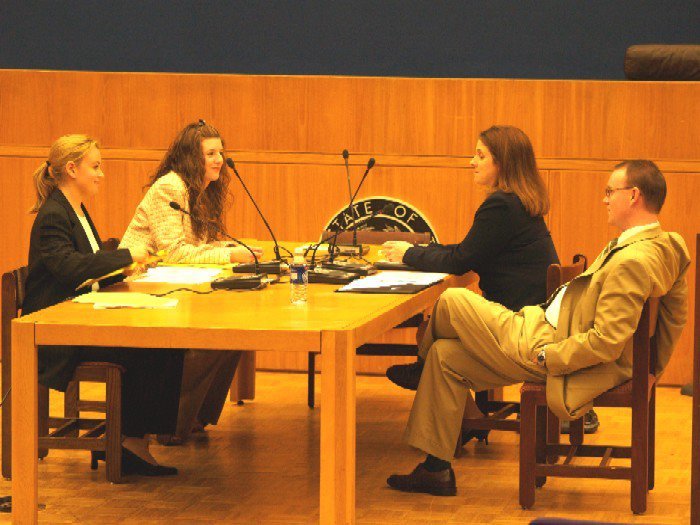
Last Friday evening, my partner and I won the Tom Newhouse Mediation Competition at the University of Houston Law Center. In the finals, my partner was counsel, and I was the client - but that had switched around during the competition. The mediation competition was a really interesting experience, and it was nice to get a championship while in law school.
Over 90% of all filed cases settle (in both state and federal courts), and a large portion of those settle through mediation - so I think this was a really practical experience.
Friday, November 11, 2005
Veteran's Day...
Today is Veteran's day.
My late grandfather served in WWII. My wife's late grandfather was a navy pilot during WWII and Korea flying planes off aircraft carriers in the Pacific. My wife's father is an Air Force veteran.
 I attended a Memorial Day event earlier this year at the Veteran's cemetary here in town. Since then I've thought a lot about how quickly we are losing the "WWII Generation." If you went into the military at 18 years old in 1945 (the last year of WWII) you would be 78 this year. And if you went in in 1945, it's reasonably less likely you would have seen combat. It's not unreasonable to think that within the next 10 years the vast majority of that geneneration will have passed - along with so much of the history and connection to those times. That seems quite surreal to me.
I thought about this a lot during August and the anniversary of the bombing of Hiroshima. It's interesting to look at public perception/opinion of that event over time. In the period just after the bomb was dropped, public opinion was overwhelmingly positive and relieved. 85% supported the attack, and there was a general sense of relief that it ended the Pacific War. Polls during the 1960s showed that African- and Asian-Americans tended to oppose the strikes more than whites; and women were more uneasy with it than men. Older folks, who had more instant memories of the War, and living through the War, were still strongly supportive, but those under 30 were much more critical and uneasy with the results of the bombing. As this younger generation - the baby boom - became the leaders ... critically including the historians ... the trend increasingly became more critical and unsupportive.
I think that a lot of that shift in public perception is due to the passing of the World War II generation. Our society is losing a lot of history as this generation fades...just as the Civil War generation passed away before that, and the Founding generation before that. (And off the top of my head, I think it's safe to divide America's history into those big categories - the Founding Generation; the Civil War Generation; and the WWII Generation...which leaves me wondering what this time is we are experiencing now - the PostModern Generation???...) In this same vein, CNN is carrying an article today related to WWI vets: Time Overtaking World War I Vets It included this graphic:
I'm not sure that since the WWII generation, veteran's are looked at in the same way any more. I think there are a lot of reasons for that - we haven't had a nation galvanizing (in a positive way... or maybe more descriptive- in a threatening way) war since; the advent of modern warfare techniques have served to desanitize war to much of the public; and modern information portals mean that there is much less "mystery" about the wars as they play out. Maybe there are other factors, and better factors as well. Regardless, it doesn't seem as if the nation as a whole is as cognizant of veteran's these days.
Anyway, the point is to remember our veteran's today - the one's who sacrificed themselves to make our nation great, the one's who served to protect us and made it home, and the one's who are still "over there" fighting for us even today.
As as a part of remembering that, I want to remember the men and women whom have lost their lives during the invasion and occupation of Iraq. There have been 2,063 American casualties in the war in Iraq as of November 11, 2005. Hopefully those still there will be safely home soon.
My late grandfather served in WWII. My wife's late grandfather was a navy pilot during WWII and Korea flying planes off aircraft carriers in the Pacific. My wife's father is an Air Force veteran.
 I attended a Memorial Day event earlier this year at the Veteran's cemetary here in town. Since then I've thought a lot about how quickly we are losing the "WWII Generation." If you went into the military at 18 years old in 1945 (the last year of WWII) you would be 78 this year. And if you went in in 1945, it's reasonably less likely you would have seen combat. It's not unreasonable to think that within the next 10 years the vast majority of that geneneration will have passed - along with so much of the history and connection to those times. That seems quite surreal to me.
I thought about this a lot during August and the anniversary of the bombing of Hiroshima. It's interesting to look at public perception/opinion of that event over time. In the period just after the bomb was dropped, public opinion was overwhelmingly positive and relieved. 85% supported the attack, and there was a general sense of relief that it ended the Pacific War. Polls during the 1960s showed that African- and Asian-Americans tended to oppose the strikes more than whites; and women were more uneasy with it than men. Older folks, who had more instant memories of the War, and living through the War, were still strongly supportive, but those under 30 were much more critical and uneasy with the results of the bombing. As this younger generation - the baby boom - became the leaders ... critically including the historians ... the trend increasingly became more critical and unsupportive.
I think that a lot of that shift in public perception is due to the passing of the World War II generation. Our society is losing a lot of history as this generation fades...just as the Civil War generation passed away before that, and the Founding generation before that. (And off the top of my head, I think it's safe to divide America's history into those big categories - the Founding Generation; the Civil War Generation; and the WWII Generation...which leaves me wondering what this time is we are experiencing now - the PostModern Generation???...) In this same vein, CNN is carrying an article today related to WWI vets: Time Overtaking World War I Vets It included this graphic:
VANISHING VETS
Estimated number of war-era veterans, including those outside of war zones, in civilian life as of September 30, 2005:
World War I: fewer than 50.
World War II: 3.526 million.
Korean War: 3.257 million.
Vietnam War: 8.055 million.
Desert Shield/Storm (theater only): 615,000.
Iraq/Afghanistan (theater only): 433,000.
Source: AP/Veterans Affairs Department
I'm not sure that since the WWII generation, veteran's are looked at in the same way any more. I think there are a lot of reasons for that - we haven't had a nation galvanizing (in a positive way... or maybe more descriptive- in a threatening way) war since; the advent of modern warfare techniques have served to desanitize war to much of the public; and modern information portals mean that there is much less "mystery" about the wars as they play out. Maybe there are other factors, and better factors as well. Regardless, it doesn't seem as if the nation as a whole is as cognizant of veteran's these days.
Anyway, the point is to remember our veteran's today - the one's who sacrificed themselves to make our nation great, the one's who served to protect us and made it home, and the one's who are still "over there" fighting for us even today.
As as a part of remembering that, I want to remember the men and women whom have lost their lives during the invasion and occupation of Iraq. There have been 2,063 American casualties in the war in Iraq as of November 11, 2005. Hopefully those still there will be safely home soon.
Tuesday, November 08, 2005
Election Day 2005 in Houston...

Today there is an off-year round of elections in Houston. There is a mayoral election, but essentially incumbent Bill White has no opposition - which he shouldn't, he is doing a fabulous job.
Here are a few resources related to the election, which includes nine propositions for amendments to the Texas state constitution. (Including the controversial same-sex marriage ban amendment.)
Houston Chronicle Election Central
HarrisVotes.com
Precinct 34 Sample Ballot
Popular [Mayor] White could make history
Houston Chronicle Recommends:
For Prop. 1
Against Prop. 2
Against Props. 3, 6, 8
For Prop. 9
Other resources:
Bill White for Mayor
Peter Brown for City Council, At large Position 1
Jay Aiyer for City Council, At large Position 2
Ron Green for City Council, At large Position 4
Ada Edwards for City Council, District D
Annise Parker for City Controller
Monday, November 07, 2005
Nail hit on head...
Dahlia Lithwick hits another home run. The Dangling Conversation
Well said.
The same devoted right-wingers who torpedoed the Miers nomination are frothing at the mouth to explain painstakingly to the nation—yet again—their theory of judging. Liberals believe that the object of these hearings is to find out what a nominee stands for. But conservatives have long understood that the real point is a mass public-relations effort to drive home their lasting, unitary view of all liberal or even moderate judges as reckless and overreaching.
It will, unless Democrats get it together, become yet another Jerry Lewis telethon, raising national awareness about the dangers of "judicial activism" and the plague of "the reckless overreaching of out-of-touch liberal elitist judges." Democrats in the Senate either will not or cannot put the lie to these trite formulations. They need to shout it from the rooftops: that blithely striking down acts of Congress is activism; that the right's hero Clarence Thomas may be the most activist judge on the current court; that reversing or eroding long-settled precedent is also activism; and that "legislating from the bench" happens as frequently from the right as the left.
.... There's no cheap sound bite for Justice Stephen Breyer's notion of "active liberty" or for Cass Sunstein's program of judicial "minimalism" or Jack Balkin's principled "centrism." Or perhaps there is a cheap sound bite embedded in those ideas—it simply hasn't been excavated yet.
The main attraction of the right wing's relentless attack on the judiciary is that its oversimplified theory of judicial restraint solves its oversimplified problem of unconstrained judges. You have to drill down a lot deeper to see that unconstrained judges are making mischief at either end of the political spectrum, and more urgently, that hogtying judges is not an end in itself. It's a means to an end—with the end, I suppose, being the packing of the courts with judges who say they believe in restraint even as they gleefully dismantle decades' worth of legislative and judicial progress.
If the Scalias, Thomases, Alitos, and Borks of the world had their way, he says, there would be no meaningful gun control. States could have official churches. Hard-fought federal worker, environmental, and civil rights protections would disintegrate. What you currently think of as the right to privacy would disappear. These are the questions Senate Democrats need to ask of Sam Alito: Should property rights trump individual rights? Should the right to privacy be interpreted as narrowly as the framers might have intended? Do you believe that a return to the morals and mores of two centuries ago is in the best interest of this nation?
It doesn't matter what he answers, indeed the answers are irrelevant. By posing these questions to the American people, the senators will give them some understanding of the America that stands to be dismantled.
Well said.
Subscribe to:
Posts (Atom)


